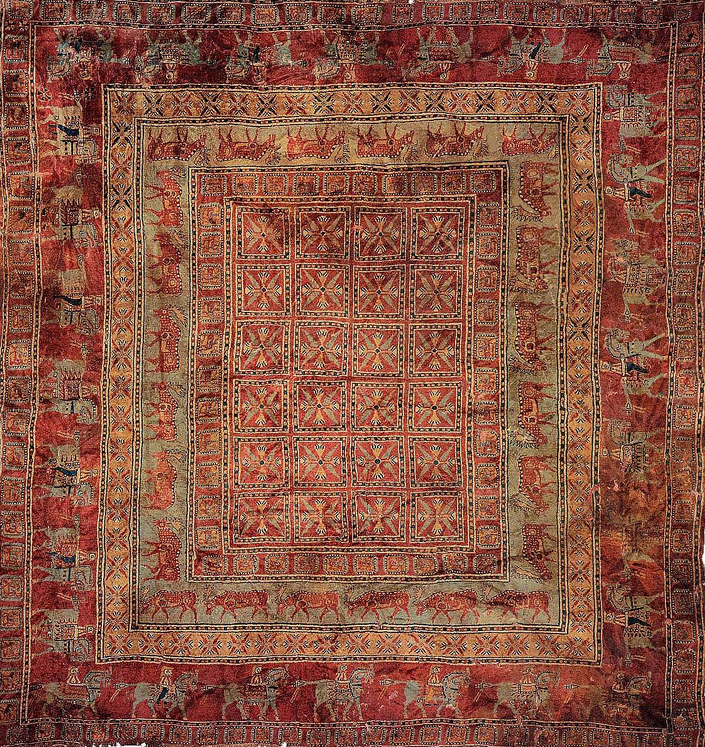
The oldest surviving knotted pile rug. This site reads it as the first fully preserved work of a Turkic weaving tradition: Turkish (Gördes) knot, kurgan burial, horse cult, and animal style.
Size ~183–189 × 200 cm
Knot Turkish / Gördes
Density ~3,600 / dm²
Now at Hermitage, St. Petersburg
What this rug is
It is a knotted pile carpet laid in an Altai elite grave in the fifth or fourth century BCE. The people who buried it, and the people who wove it, belong to the same Inner Asian world later named Hun, Saka and Scythian — a Turkic world.
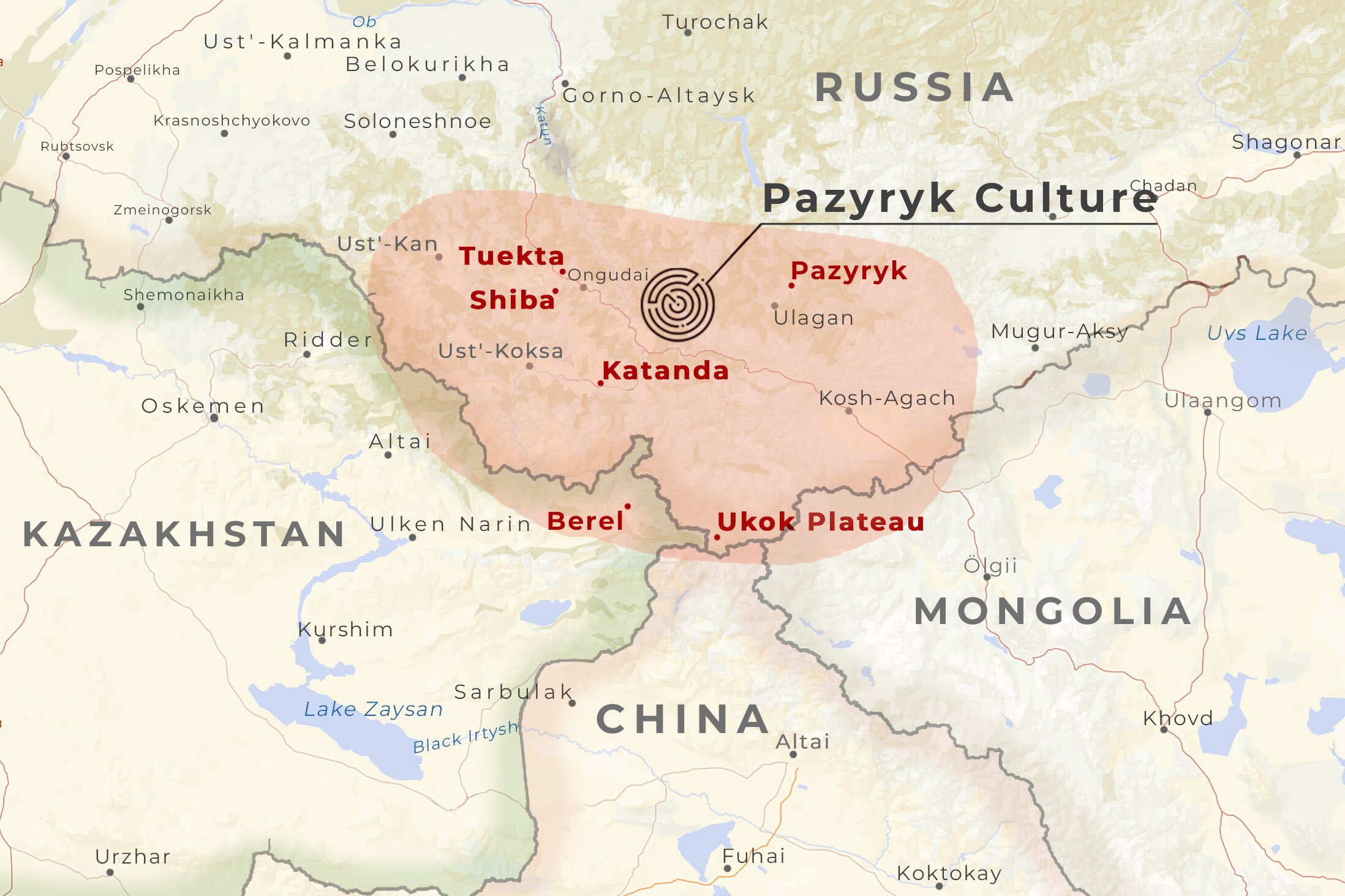
The Altai is the mountain knot where Russia, Kazakhstan, Mongolia and China meet. High valleys, permafrost and stone kurgans hold the Pazyryk culture: Pazyryk itself, Tuekta, Shibe, Katanda, Berel and the Ukok plateau. Kurgan 5 sits in that cluster, in the Pazyryk Valley of the Russian Altai, above the Ulagan district. Ice, not a museum, kept the wool.
The object itself says so. The pile is tied with the symmetrical double knot that Turkish and Turkmen weavers still call Gördes. The grave is a stone-covered kurgan with a timber chamber and sacrificed horses. The programme on the cloth is horse, deer and griffin — the old steppe animals, not a palace garden. The red dye is a northern insect, not the kermes of the Iranian plateau. These are the facts of the find (Rudenko, 1970; Böhmer & Thompson, 1991; Aslanapa, 2005; Yeşildal, 2018; Çeken & Bal, 2026; Rejepova, 2021).
Riders on the border share a pose with Persepolis stone (Rudenko, 1970, p. 304). Courts copy courts. That does not move the loom. The knot, the grave, the horse marks and the dye stay where they were made. How Rudenko’s Persian-workshop reading sits against those facts is set out in the next section. The rest of the page simply names what is on the cloth.
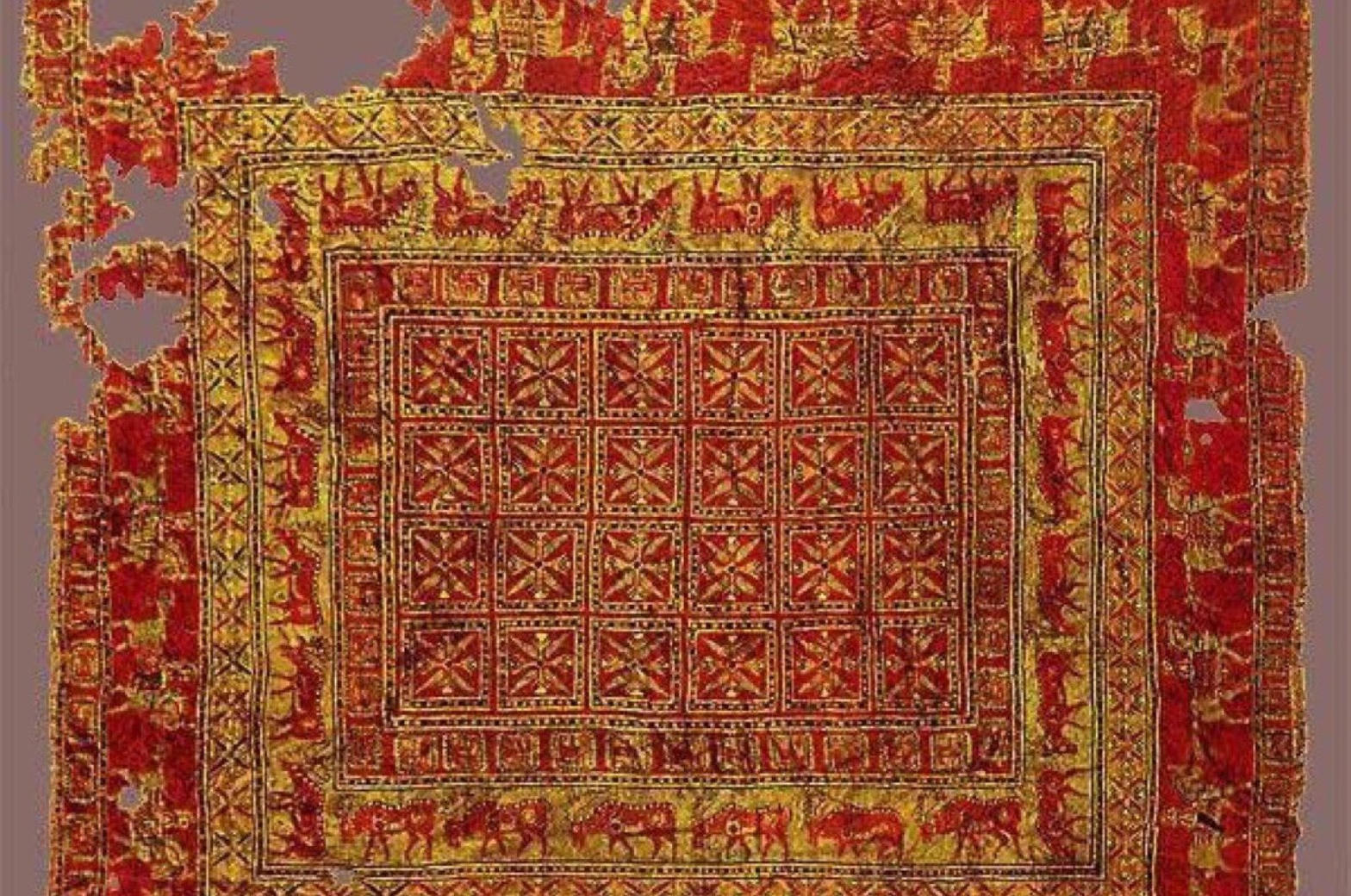
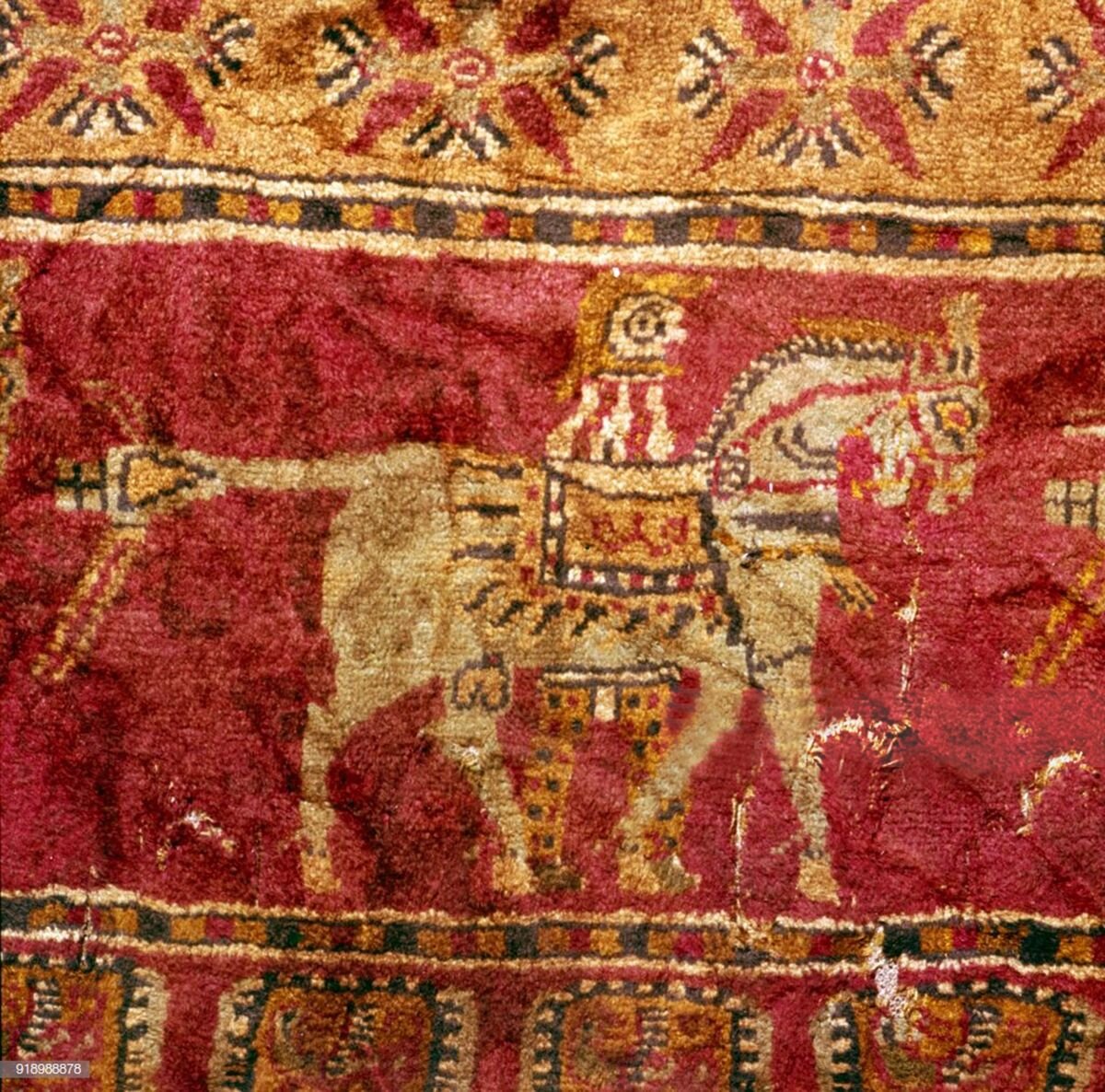
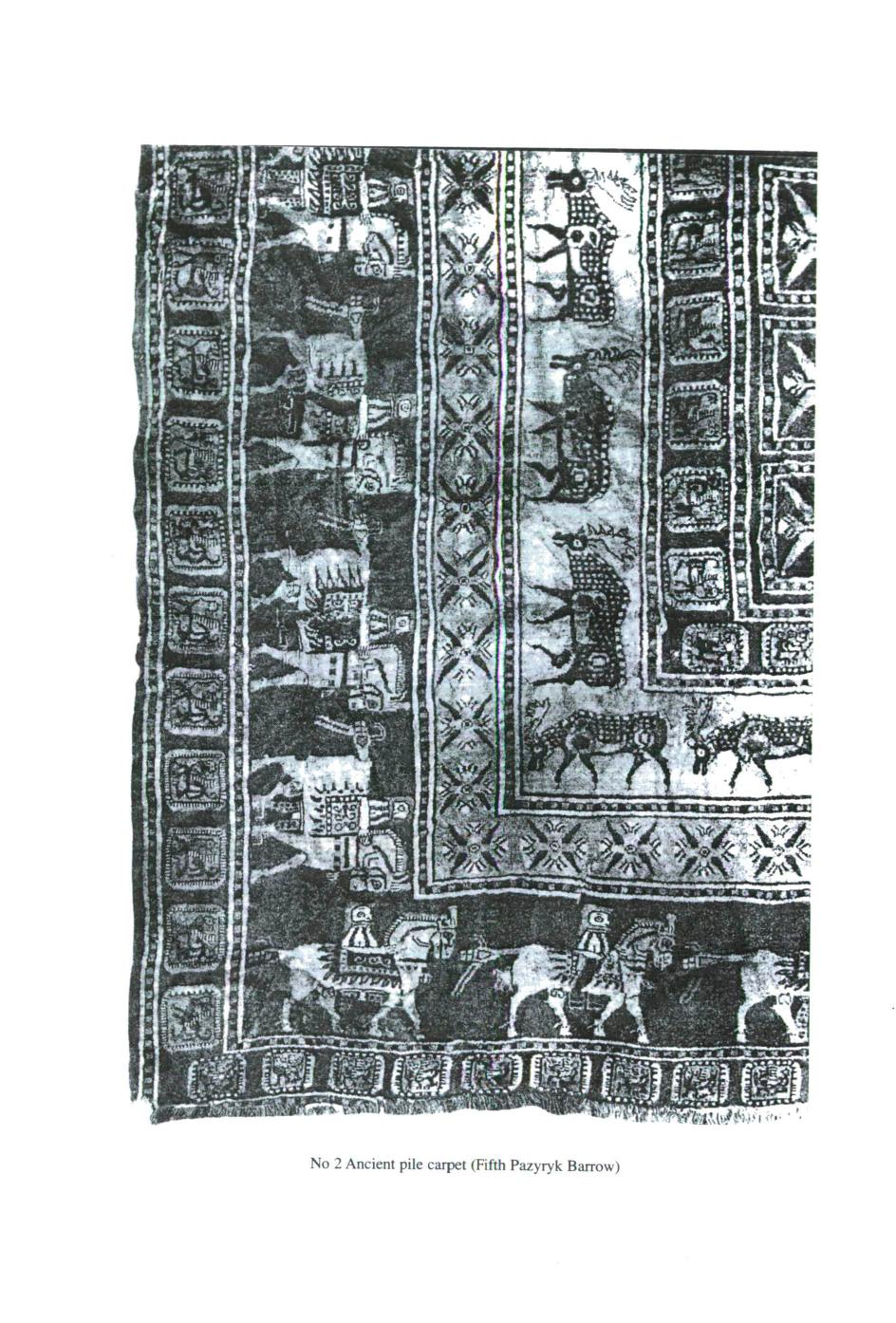
Digitally reconstructed full view. Centre: 24 lotus-star squares (the Turkmen göl / lake field). Then griffin, deer, star, horseman and outer griffin friezes. This is the image used throughout the page when the ice-worn original is too dark to read.
Even if one set aside knot, geography and the other grave goods, the deer, horse and griffin figures alone are an important sign that the Pazyryk carpet belongs to the Turks.
— Yeşildal (2018), 2nd International Turkic World Congress, vol. 3.
Five lines of evidence used here
The knot. Symmetrical double knot — the Gördes / Turkish knot. Rudenko recorded it; Böhmer and Thompson (1991) measured a Hermitage fragment and named the knot “Turkish.” Saryk Turkmen used the same knot at the same density.
The grave type. A stone-covered kurgan with a timber chamber, sacrificed horses, and textiles — the classic Inner Asian elite burial (Çırpıcı, 2015; Rudenko, 1970).
The horse. Cropped mane, knotted tail, carpet-like shabrak (saddle cloth). These are old Turkic war- and mourning-horse marks, still visible in later Turkic sources (Yeşildal, 2018; İnan, 1998; Dīwān Lughāt al-Turk).
The Scythians are Turks. No ancient source calls them Indo-European. Tzetzes’ Scythian sentence is Turkic; Ogur geography and Hun-Turk archaeology put the Altai horsemen inside the early Turkic world (Şengül, 2024; Çeken & Bal, 2026; Yeşildal, 2018; Çırpıcı, 2015).
The dye. The red is a northern steppe insect dye, not Ararat kermes from the Iranian plateau (Böhmer & Thompson, 1991). Synchrotron work later showed fermentation matching Anatolian wool recipes (Späth et al., 2021).
Reply to Rudenko
Before the points, a reason for writing this section at all.
Sergei Ivanovich Rudenko opened Kurgan 5 in 1949 and published the English monograph in 1970. Almost everything we still know about the find passes through his notebook: the size of the cloth, the count of the knots, the five friezes, the ice that saved them. That record is not in dispute. What is in dispute is the last inference he drew from it — that because some riders on the border resemble the gift-bearers carved at Persepolis, the carpet itself must have been woven in a Median, Parthian or Persian workshop and sent north as gift or tribute (Rudenko, 1970, p. 304).
The difficulty is not that Rudenko saw the resemblance. The pose is real, and it is left standing on this page. The difficulty is that a shared picture is not a birth certificate. Motifs travel easily along a tribute road. A knot tied on two warps does not. A stone-covered kurgan with sacrificed horses does not. A northern insect red, a shaved mane and a tail bound for mourning do not. Those things stay with the people who bury their dead that way. Rudenko measured several of them and then set them aside when he named the workshop. The pages that follow simply pick those measurements up again and read them in the order the grave itself suggests.
He is quoted first, in his own words or close to them. Then the same passage is walked again, more slowly.
Rudenko, 1970, p. 304 — the riders
He saw Persepolis in the horses
The horse’s neck is sharply bent, the mane cropped, the forelock a plume, the tail knotted. A fringed shabrak replaces a hard saddle. The groom walks at the horse’s left with his right hand on the back — the tribute pose of Persepolis. Tail-knot and plume appear there, on a sword from Chertomlyk, and on a plate from the Oxus treasure. Workmanship Median, Parthian or Persian; most probably the fifth century BCE.
Persepolis did carve men who brought horses. A court that takes tribute will always draw the people who pay it, and a weaver who has seen that court, or heard of it, may set the same walk upon a border. Fashion moves. That much can be granted without moving the loom.
Look again at the same horses. The tail is not only knotted as a plume of court. In the old Turkic sources it is bound or cut when a man is mourned — tullamak, to widow the horse (Kashgari I/472; Dede Korkut; İnan 1998/2000; Yeşildal 2018). The mane is shaved. The cloth under the rider is felt, of the kind the Altai itself sewed and painted. Those marks do not appear as a set on the palace wall. They belong to the funeral that laid this carpet down. A shared pose can live at both ends of a road. The mourning horse lives at only one of them.
Rudenko, 1970, p. 302 — the deer
He named a fallow deer of the Near East
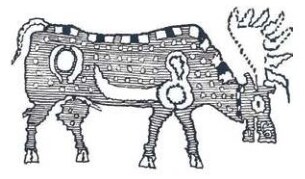
At first glance the antlers look like elk. Spots, muzzle and body then suggest fallow deer. Broad palmate antlers and the comma-and-disk on the foreleg, running into a belly stripe, are a distinctive feature of Achaemenid Near Eastern animal depiction.
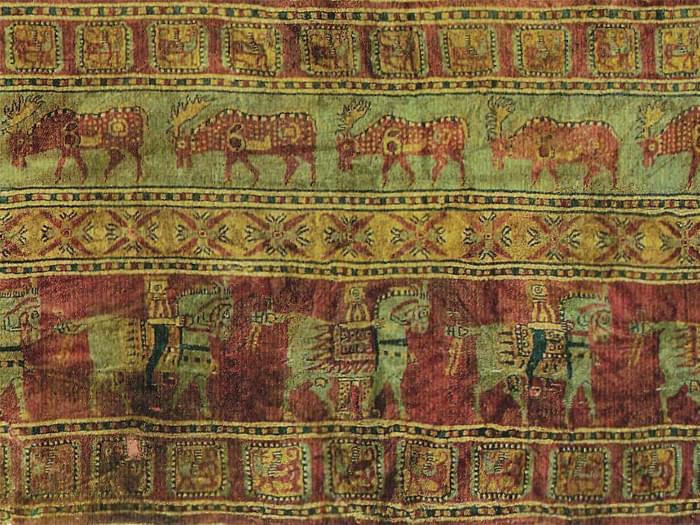
The comma, the disk and the stripe are marks Rudenko himself lists elsewhere as local Altai animal style — the dot, the comma, the half-horseshoe (1970, pp. 273–274). Twenty-four deer walk one way. Twenty-eight horses walk the other. That is not a plate from a zoologist’s book. It is a closed circuit, two companies passing in the dark.
Kirghiz Bugu clans still count the stag as ancestor. Siberian verse still says the animal I ride is the deer, the elk. Hun stories still send a deer ahead as guide (Yeşildal 2018; Sarıyev 2022; Çeken & Bal 2026; İnan 2000). A palace workshop might copy a spotted hide. It would not bury twenty-four of them, walking against the funeral horses, in an Altai mound.
Rudenko, 1970, p. 257 — the griffin
He derived the bird from Assyria and Persia
Two types: the eagle-griffin, Assyrian, with eagle foreparts, lion hind and a comb of feathers; and the horned winged lion-griffin of Achaemenid art, whose club-tipped horns exist only in Persian work. A leather saddle-cover from Kurgan 1 shows the two types fighting.
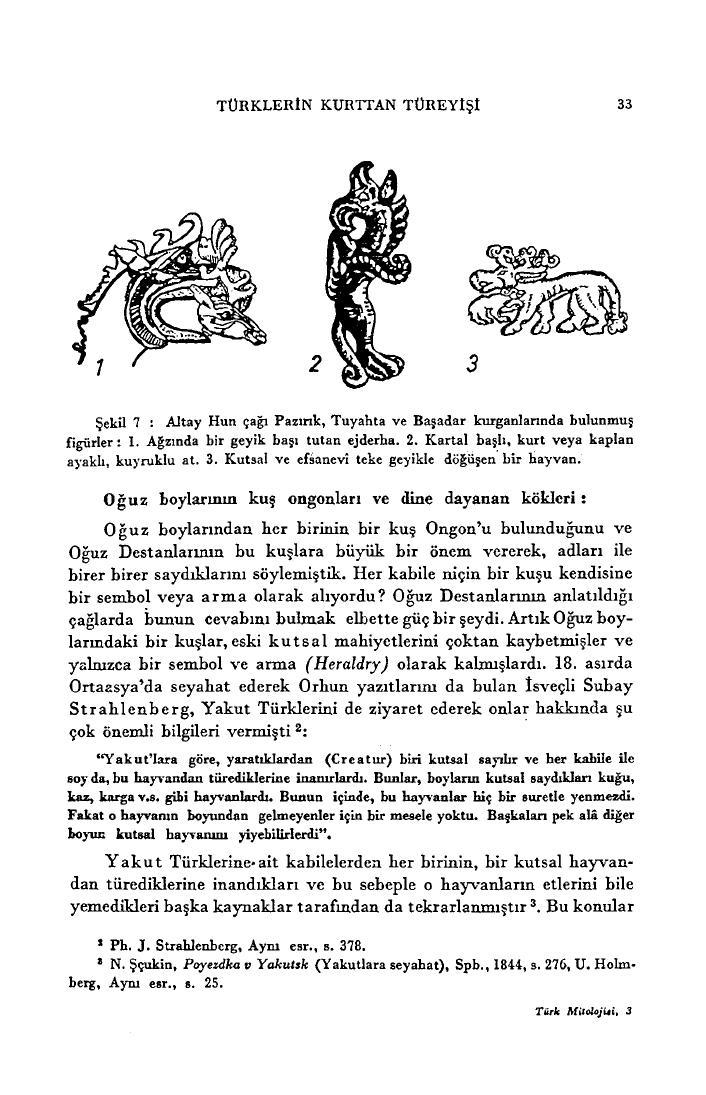
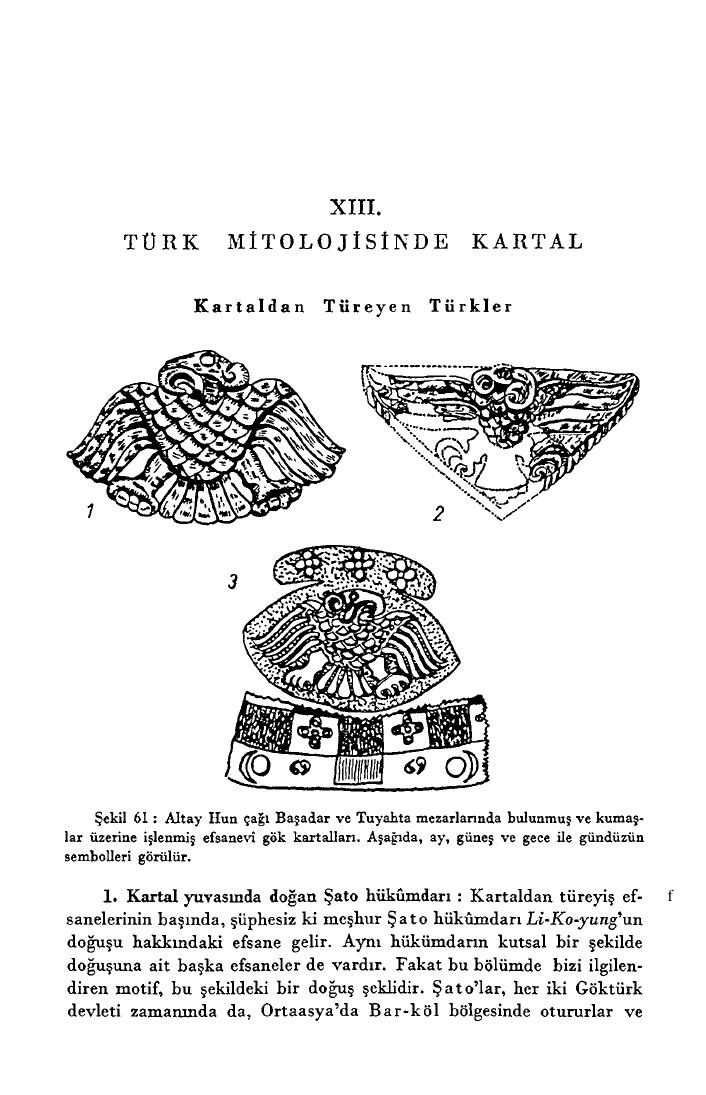
Winged hybrids walked the gates of Assyria and the stairs of Persepolis. That is true, and it does not settle who tied these knots. Ögel prints the same eagle-lion from Pazyryk, Tuekta and Bashadar and labels the mounds Altay Hun çağı. In his plates a dragon holds a deer in its jaws; an eagle-headed horse stands on wolf or tiger feet (Ögel, Türk Mitolojisi I, 1993, Şekil 7). Chapter XIII of that book is called, simply, Türk Mitolojisinde Kartal — the eagle in Turkish mythology.
There the eagle is Tengri’s messenger and the highest animal-spirit of the Yakut Turks. Noble houses were eagle-clans. A shaman arrives on earth by eagle. The soul of the future shaman is taken by the bird, laid as an egg on the world-tree, and hatched under Eagle-Mother. Kartal-Ata, Eagle-Father, stands with Deer-Father and Bear-Father as one of the three oldest animal-ancestors of Inner Asia (Ögel I, pp. 34–38, 595–598). The double sky-eagle sits on the world-pole.
That is the creature on this rug: the eagle of the sky joined to the feline of the earth, later called kartal and ejder, in Kazakh still italakaz, the dog-goose. The Greeks, who stood far to the west, called the Altai people themselves the griffins who guard gold. A fight on a Kurgan 1 saddle shows that the type lived in these graves. It does not show that the weaver had come from Nineveh (Malayev; Çoruhlu, 2002; Balcı, 2012). Cousins of a motif may be found in many houses. The house that wove this one is the house that buried it.
Rudenko, 1970, p. 302 — the knot
He counted the knot and did not name it
A double knot on two warps; some three thousand six hundred knots in a square decimetre; weft every three or four rows; pile shaved to two millimetres. At Bashadar a different “one-and-a-half knot,” whose origin in Central or Near Asia seemed to him beyond doubt. The Pazyryk double knot he left without a national name.
The knot he counted is the knot later Turkish and Turkmen looms still call Gördes — the symmetrical knot, two warps taken together (Aslanapa 2005; Yeşildal 2018; Öztürk 2025). A later team working with a Hermitage colleague simply wrote “Turkish knots,” as if the name no longer needed an argument (Späth et al., 2021). The later Persian court tradition preferred the asymmetrical family, the Senneh knot. Rudenko’s own numbers, read without the palace in mind, already lean away from the workshop he proposed and toward the one that kept this knot for the next twenty-five centuries.
Rudenko, 1970, throughout — the workshop
He inferred a palace from a royal object
Fine wool, more than a million knots, riders who look Achaemenid: the picture that forms is of a palace or city workshop sending a finished carpet into the Altai as gift, tribute or trade.
The cloth did not come to light on a palace floor. It lay under stone and timber, in a row of sacrificed horses, among felt hangings sewn with animals and beside a second, much larger felt carpet (Çırpıcı 2015). That is the furniture of an Inner Asian elite grave. To bury the horse with the man is an old Turkic rite; the mount is expected to serve again (Radloff; Yeşildal 2018). The red in the pile is a northern insect dye, fermented in a manner that later matches Anatolian wool, not a lost recipe of the Iranian plateau (Böhmer & Thompson, 1991; Späth et al., 2021).
A court may well have wished for such a cloth. Wishing is not weaving. The people who could tie a million symmetrical knots, dye them with the steppe insect, and lay the finished rug in a kurgan with the horses, are the horsemen of this valley.
What remains of Rudenko
The date remains — fifth or fourth century BCE. The measurements remain. The five friezes remain. The rhyme between some riders and Persepolis remains, as a rhyme, not as a maker’s mark.
What falls away is only the last step: from a shared pose to Median, Parthian or Persian workmanship. The quieter reading of his own catalogue is simpler. A Saka or Hun-Turk workshop used a courtly picture-language on a Turkish knot, and buried the cloth where such people bury their dead.
Kurgan 5: how the rug survived
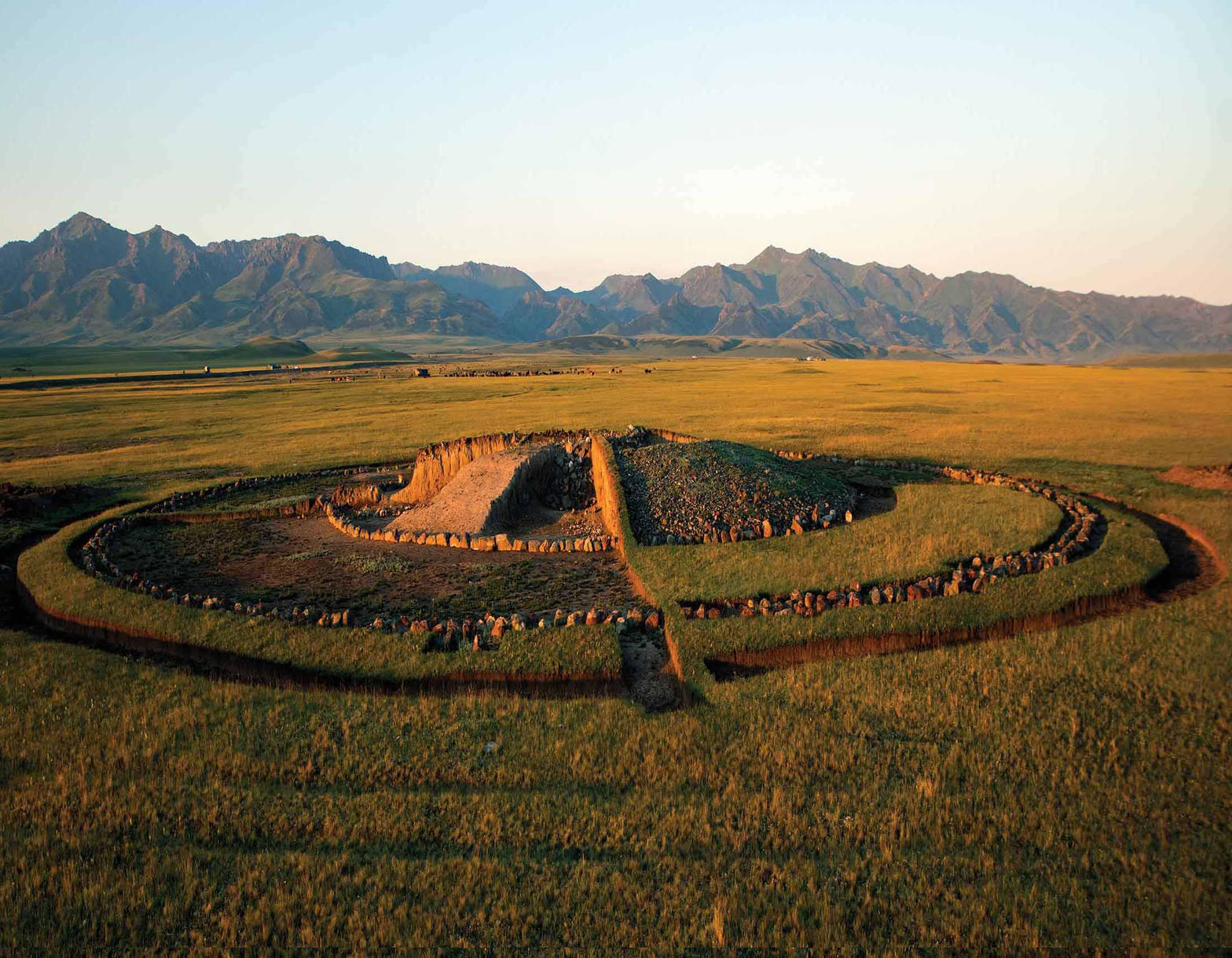
A kurgan is a burial mound: a timber chamber sunk into the ground, then heaped with earth and stone. In Turkic and Inner Asian archaeology it is the elite tomb of the steppe (Çırpıcı, 2015).
Kurgan — from a Turkic–Mongolic word for “fortified mound / barrow.” Archaeologists use it for the circular stone-and-earth tombs of the Altai, Kazakhstan and the Pontic steppe. Pazyryk Kurgan 5 had a stone cairn about 4 m high and 42 m across; the grave pit was about 4 m deep (Barkova & Gavrilenko, 1999; Çırpıcı, 2015).
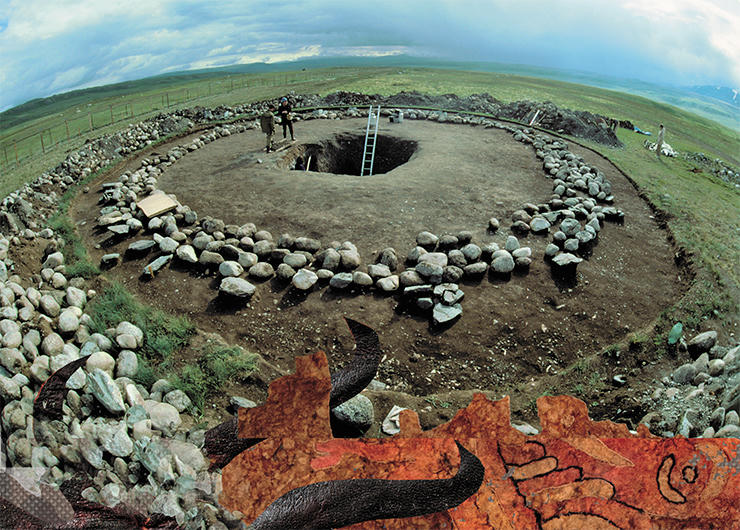
Rudenko opened the first large Pazyryk mound in 1929 and returned in 1947–1949. Kurgan 5, excavated in 1949, held the pile carpet (Rudenko, 1970, p. 174; Xalîkanî, 2025). The chamber had already been robbed. Thieves left the shaft open; meltwater entered and froze. Permafrost then sealed wool, felt, wood and even tattoos that would otherwise have vanished (Rudenko, 1970; Çırpıcı, 2015).
The same chamber contained more than a floor covering. There were sacrificed horses in rows, felt wall hangings with appliqué animals, a four-wheeled carriage, and a second, much larger felt carpet (about 640 × 450 cm) (Çırpıcı, 2015, figs. 6.62–6.65). Horse burial with the dead is a long-lived Turkic practice: the mount is expected to serve its owner in the next world (Radloff, 2008; Yeşildal, 2018).
Çırpıcı’s 2015 proficiency thesis treats the Pazyryk kurgans as monuments of Central Asian Turks: geography, belief, horse funerary custom, and the objects themselves, studied in the Hermitage (Çırpıcı, 2015). That is the frame used here.
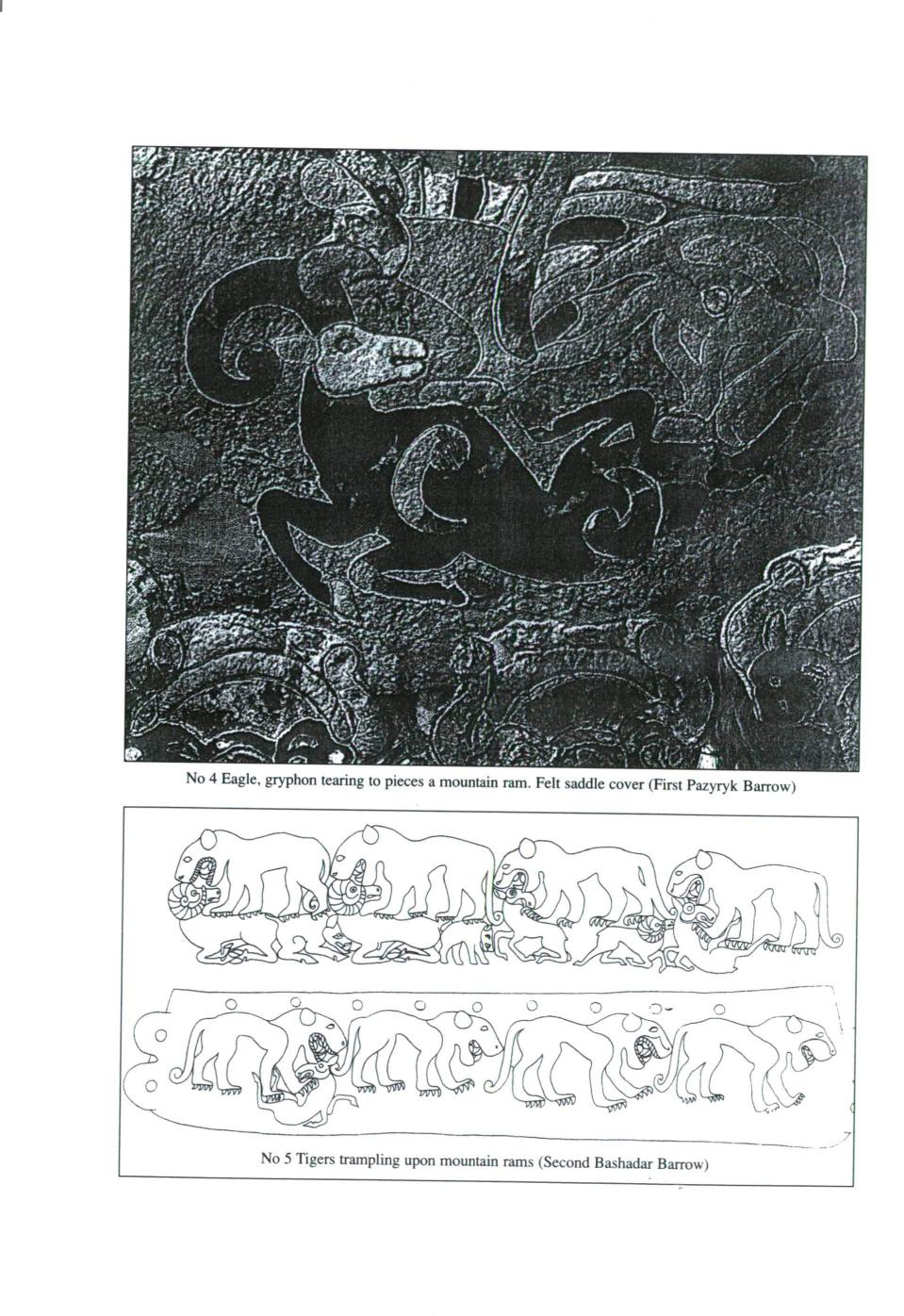
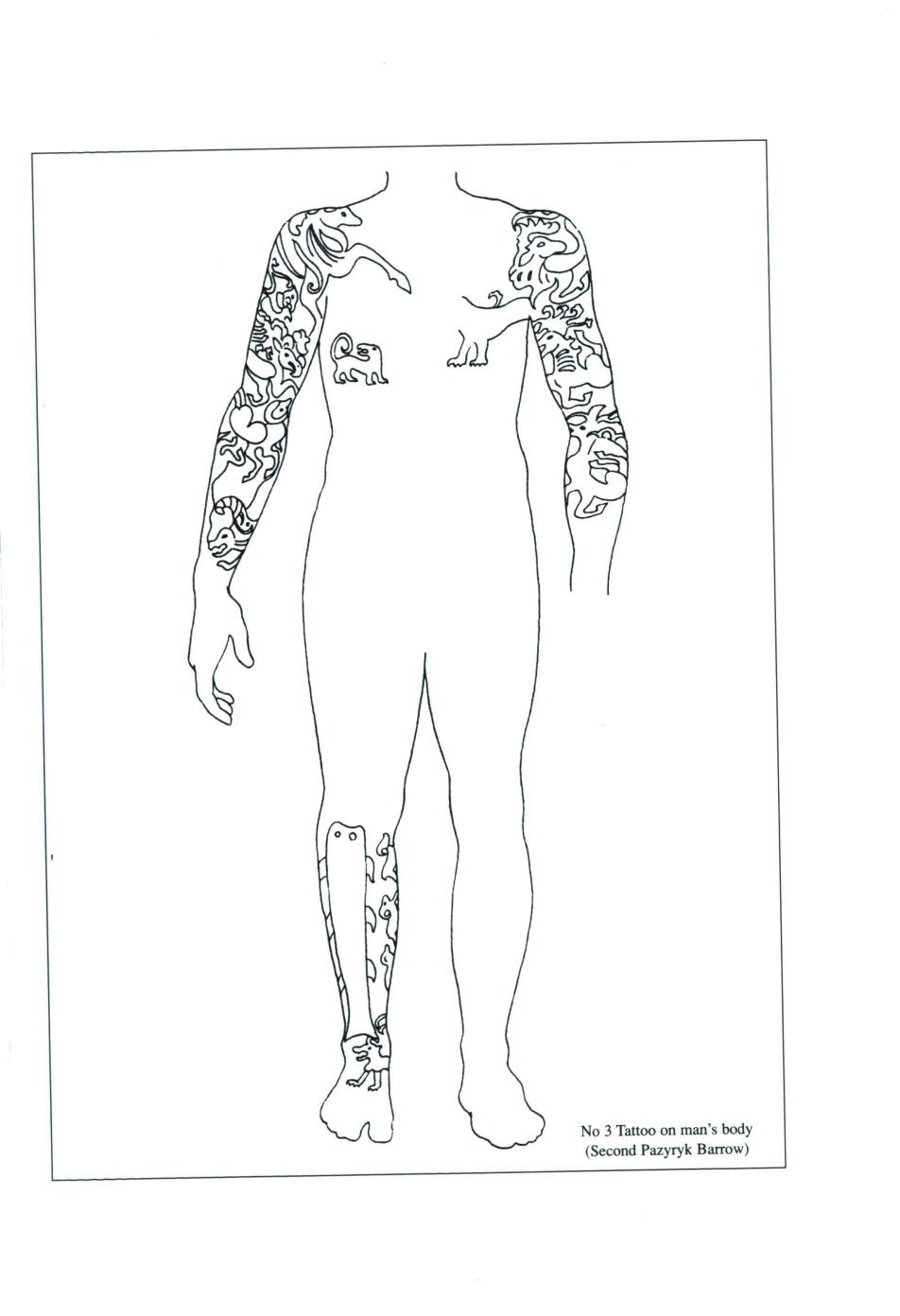
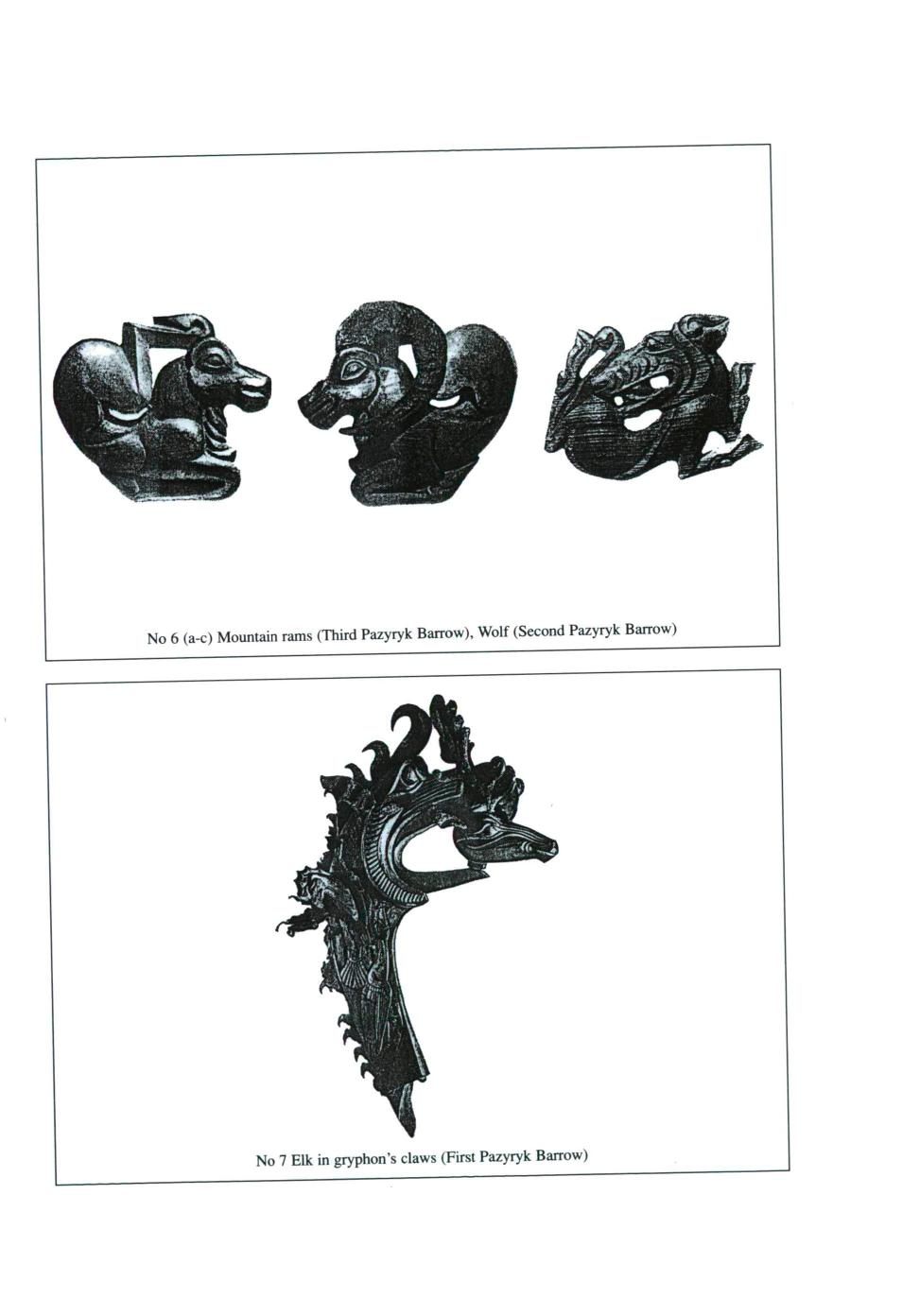
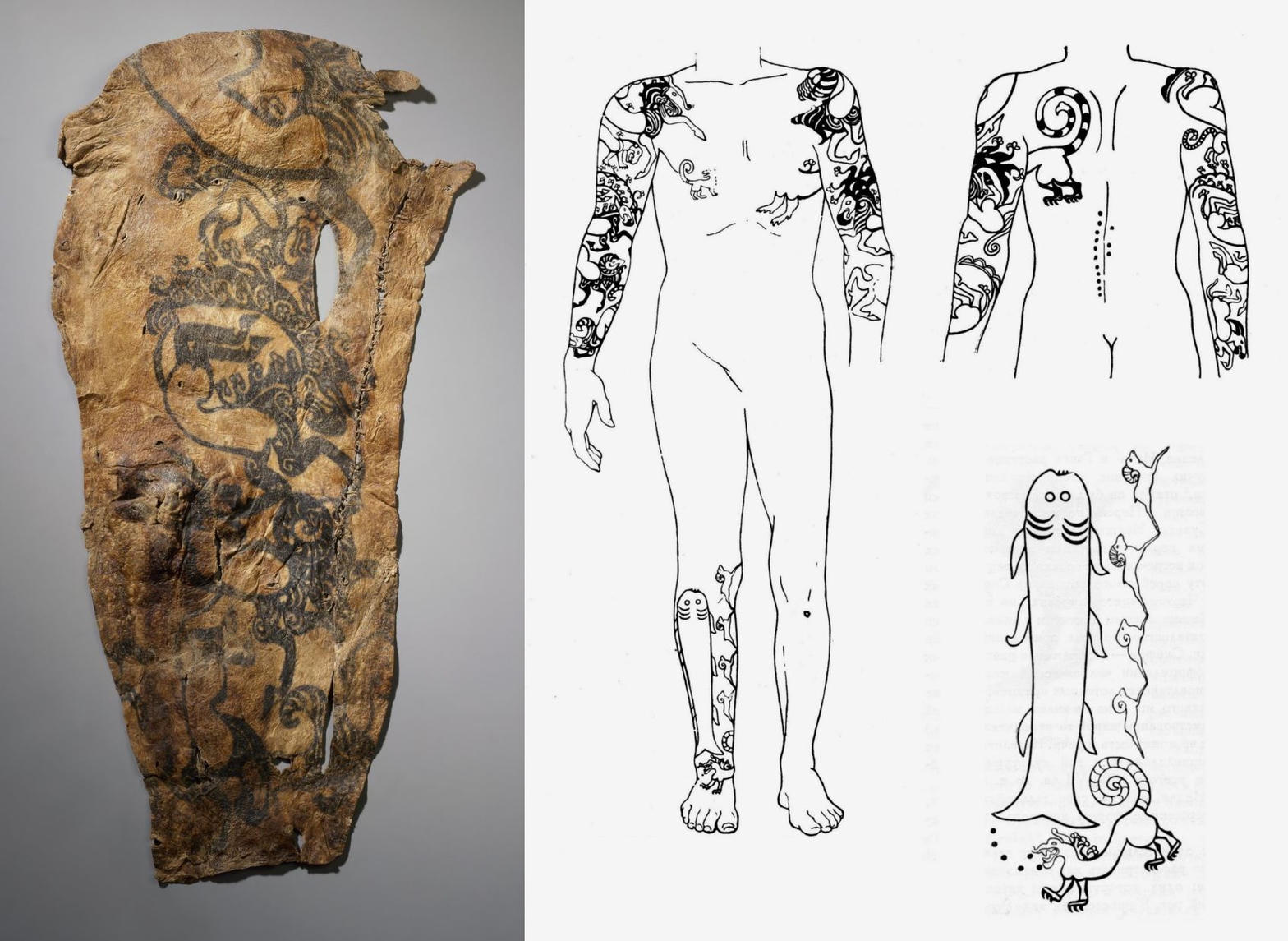
The carpet does not sit alone in that chamber-world. The same barrow group produced griffin-and-ram combat on felt saddles, twisted rams and wolves in wood, an elk in a griffin’s claws, and a man tattooed with the same animal war (Rudenko, 1968; Malayev). Those objects are local Altai work. A palace import would have to explain why it speaks the same death-language as the coffins and the skin.
A stone-ringed kurgan on the Altai steppe. Pazyryk tombs sat under mounds of this kind.
The Pazyryk culture in the Altai, where Russia, Kazakhstan, Mongolia and China meet. Red labels: Pazyryk, Tuekta, Shibe (Shiba), Katanda, Berel and the Ukok Plateau — the same kurgan group that held the rug.
The Turkish knot — the strongest technical argument
A pile carpet is not a flat weave. Each coloured tuft is tied around warp threads, then cut. The way that knot is tied is a cultural fingerprint.
~183–189 × 200 cmpublished measurements
~3,600 / dm²knots per square decimetre
~1,250,000total knots
~2 mmtrimmed pile height
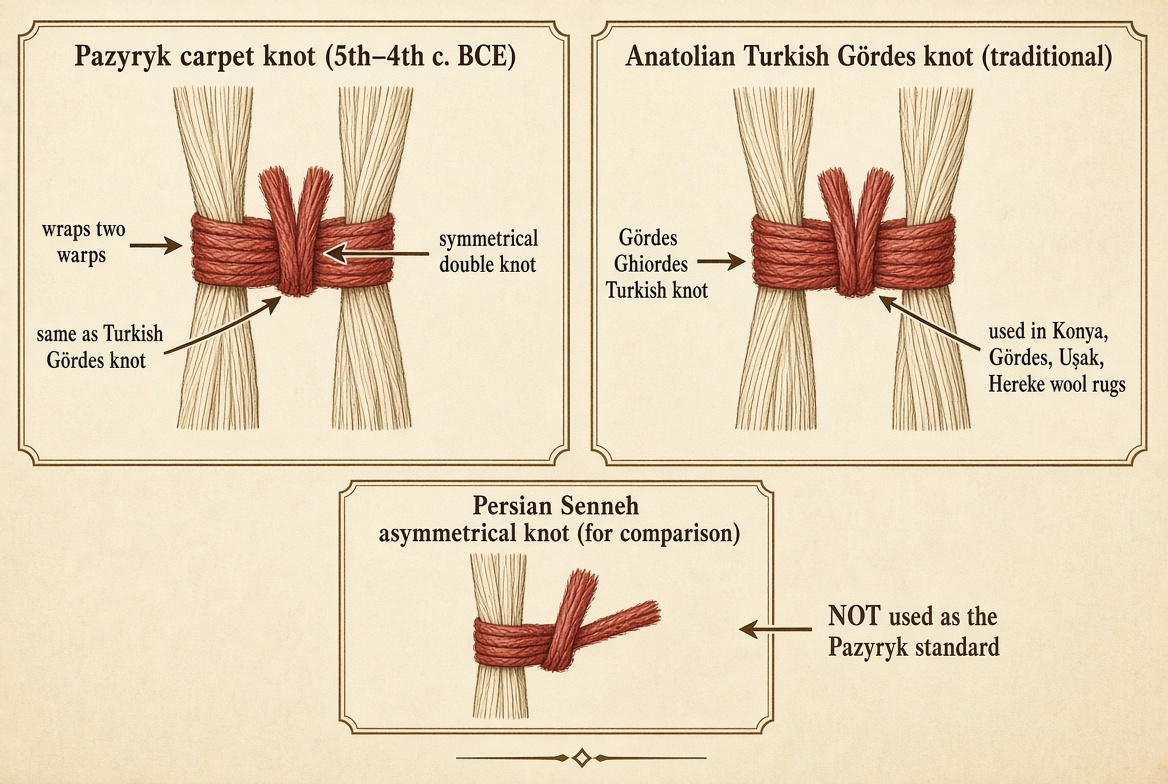
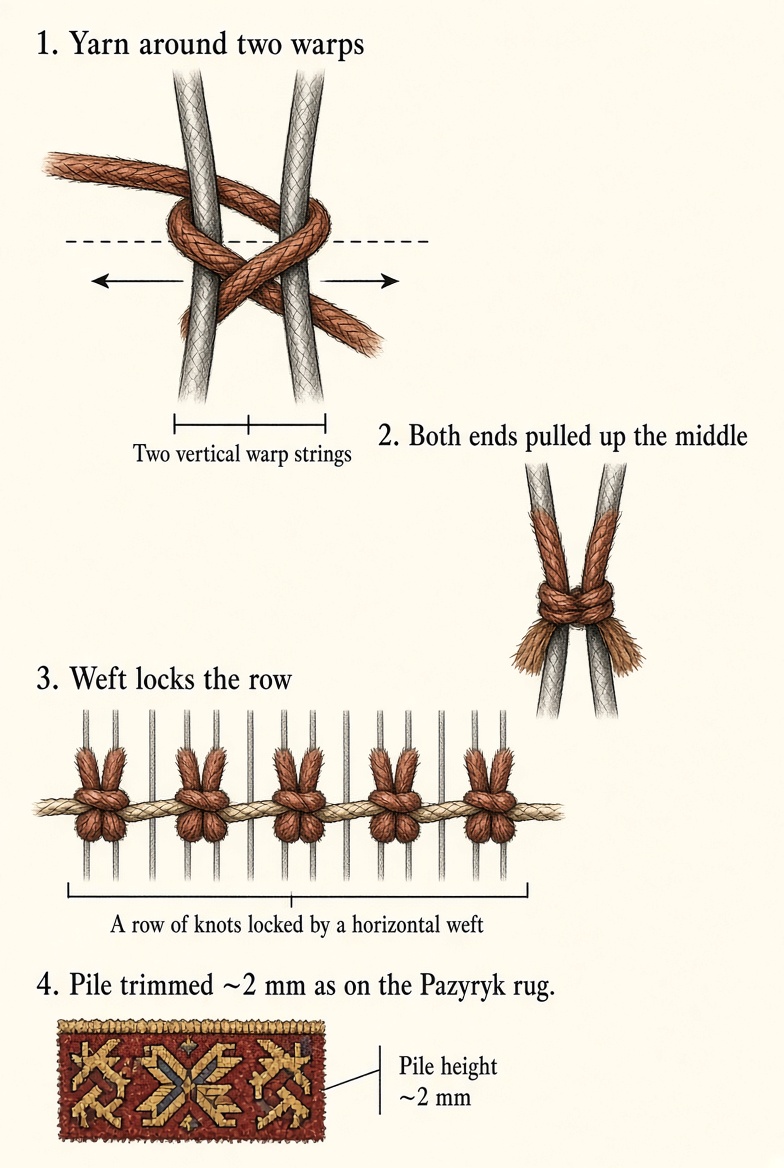
Warp — the lengthwise foundation threads stretched on the loom. Weft — the crosswise threads shot between the warps after each row of knots, to lock the row. Pile — the cut ends of the knotted yarn that form the fuzzy face of the rug. Turkish / Gördes / Ghiordes / symmetrical knot — the yarn wraps both warp threads and comes up between them, so the two ends stand as a pair. Named after Gördes in western Anatolia, where the knot remained the standard of Turkish workshops. The opposite type is the asymmetrical (Senneh / Persian) knot, which wraps only one warp.
Rudenko recorded a double (symmetrical) knot on the Pazyryk carpet: about 120 warps per square decimetre; each knot tied around two warps; one weft after every three or four knot rows; fringe left 1–1.5 cm; pile shaved to about 2 mm (Rudenko, 1970, p. 302; Xalîkanî, 2025). That is ~3,600 knots/dm² and more than 1.25 million knots on the whole cloth (Xalîkanî, 2025; Çırpıcı, 2015). Yeşildal states the same density as 36 Turkish knots per square centimetre (Yeşildal, 2018). Späth et al. (2021) independently describe “~360,000 Turkish knots” on the 1.83 × 2.0 m field.
A single weaver would need on the order of a year and a half (Hermitage estimates cited in secondary literature). This is not a first experiment. Density this high implies a school already several generations old (Späth et al., 2021).
Bashadar: a second Altai pile fragment
In 1950 Rudenko opened Bashadar (Başadar) kurgan 2, near the Karakol / Ursul rivers. He found scraps of another wool pile textile, used as a saddle cover, dated around the early 6th century BCE. Density was even higher — about 7,000 knots/dm² — but the knot was different: a “1½ knot” (single plus half), with looser pile ends (Rudenko, 1970, p. 302; Xalîkanî, 2025). Two pile techniques therefore already existed in the Altai. Pazyryk uses the one that later becomes the Turkish standard.
Aslanapa put the point without ornament: 1.89 × 2 m, 36,000 Gördes knots per 10 cm², 2 mm wool pile (Aslanapa, 2005, cited in Çeken & Bal, 2026). Öztürk (2025) warns that the knot has sometimes been misnamed in the literature; the correct technical name is the Turkish / Gördes knot (Çeken & Bal, 2026).
Same knot, twenty-five centuries apart
The resemblance is not a metaphor. It is the same mechanical act. In both Pazyryk and a traditional Anatolian Gördes rug the coloured yarn:
passes between two neighbouring warps;
wraps both warps;
comes up the middle so that two pile ends stand as a pair;
is locked by a weft shot after the row;
is shaved to a short, even pile (about 2 mm on the Pazyryk cloth).
That is why carpet literature, the Hermitage technical notes, Scientific Reports (2021) and Wikipedia’s knotted-pile entry all call the Pazyryk knot the Ghiordes / Turkish knot. The later Persian standard — the Senneh / asymmetrical knot — wraps only one warp. It is drawn below only to show what Pazyryk is not.
Density also sits inside the Turkish range, not outside it. Approximate published figures: Pazyryk ~3,600–4,300 knots/dm²; Seljuk Anatolian rugs of the 12th–13th centuries ~1,500–1,800; classical Uşak ~1,800–2,500; Hereke wool ~2,500–3,500; Hereke silk higher still. Pazyryk is already at Hereke-wool density in the Iron Age.
Böhmer and Thompson, 1991 — a carpet historian’s measurement
Harald Böhmer and Jon Thompson were allowed to examine a small fragment kept in Ludmilla Barkova’s office at the Hermitage. Their published count is the one to use when numbers are argued (Böhmer & Thompson, 1991, n. 10):
Two conclusions in that paper matter more than the count. First: designs travel; technique does not. “The claim that the Pazyryk carpet was made in Achaemenid Persia because it has Achaemenid designs carries little weight from the carpet specialist’s point of view” (Böhmer & Thompson, 1991, p. 30). Second: the red pile is an insect dye whose carminic-to-kermesic ratio matches the northern steppe species (Porphyrophora polonica and related Kazakh insects), not Ararat kermes from the Iranian plateau. That is “strong evidence that the Pazyryk carpet did not come from the Iranian plateau, but farther to the north” (pp. 33–34). The same insect red is in the local felts of Kurgan 5. Wool fibre diameters of carpet and felts are not significantly different.
They also note that nineteenth-century Saryk Turkmen wove functional Turkish-knotted tent bags at the same or higher density. The knot that survives on the Pazyryk cloth is the knot those Turkmen still tied. Böhmer and Thompson leave open an urban Central Asian workshop versus a local copy; they close the Iranian-plateau door. This page takes the next step their dye and knot data allow: that Central Asian workshop sits inside the Turkic world that later weaves Gördes rugs in Anatolia and göl rugs in Turkmenistan.
Left: the knot Rudenko measured on the Pazyryk carpet. Right: the Gördes knot of Konya, Gördes, Uşak and Hereke wool rugs. Below: the asymmetrical Senneh knot, the later Persian type — not the Pazyryk standard.
How the knot is made: wrap two warps, pull both ends up the middle, lock with a weft, trim the pile. This sequence is still taught in Anatolian workshops.
Overall view. Centre field of 24 squares, then griffin, deer, floral and rider borders.
Why the knot matters for origin: an Achaemenid court could own a rug. It does not follow that Persepolis invented the symmetrical knot. The knot that survives on this object is the knot Anatolian and Turkmen weavers still call Turkish. Combined with a kurgan, a horse burial and Altai animal style, it is the most economical attribution.
How to read the design
Rudenko separated figures (animals and riders), patterns / ornament (geometric borders) and motifs (repeating stars and rosettes) (Rudenko, 1970, pp. 29–30, 181–186; Xalîkanî, 2025).
From the centre outward (Rudenko, 1970, p. 300; Xalîkanî, 2025):
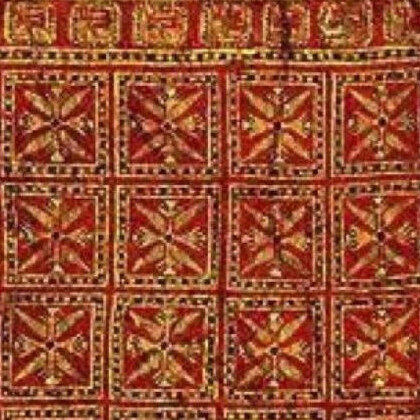
Centre field. Twenty-four squares — six along the long side, four along the short — each holding a four-rayed star joined to four flowers (lotus / water lily).
Floral / star band. About 68 small four-flower and four-ray units.
Widest frieze. Twenty-eight men and horses moving against the deer. Some ride; some walk at the horse’s left shoulder, hand on the back — the Persepolis tribute pose that Rudenko noted (1970, p. 304).
Outer griffin frieze. About 92 griffins, facing the opposite way from the inner row.
24 squares: lotus and the four quarters
From the original pile. Çeken and Bal read the cross-shaped blossom as a sun / water-lily sign of rebirth, and the four-way square as the old Turkic tört bulung — the four corners of the world (Tekçe, 1993; Çeken & Bal, 2026).
Griffin: sky and earth
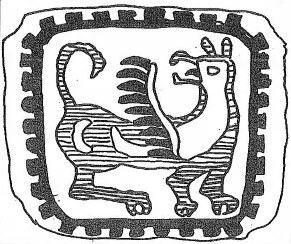
From the original pile — the outer boxed band. Eagle head, lion body. Ögel treats the same hybrid as an Altaic Hun-age type and gives the eagle a chapter as Tengri’s messenger (Ögel, 1993, Ch. XIII).
Horse and rider
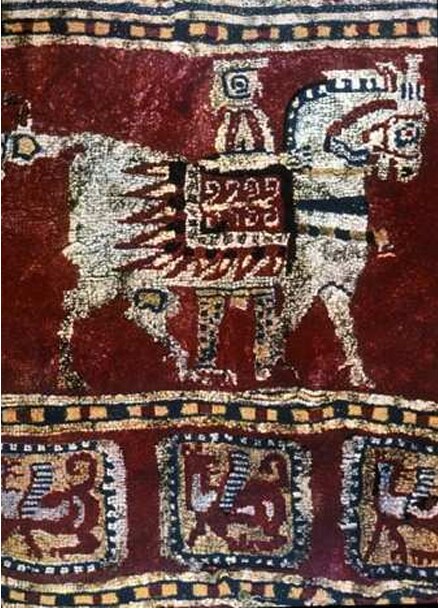
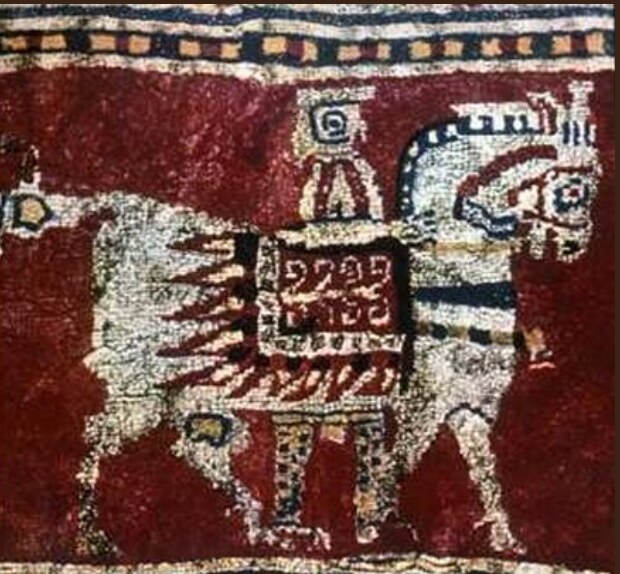
From the original pile. Cropped mane, knotted tail, felt shabrak, pointed cap (Rudenko, 1970, p. 304). “The horse is the wing of the Turk” is a steppe fact (Kashgari; Özkartal, 2012).
The griffin — guardian, road, and sky
On this carpet the griffin is not a borrowed palace beast set down for ornament. It walks the outer and inner narrow bands, boxed in stepped frames, one after another. Eagle head, lion body, wings half-lifted: sky and earth sewn into a single animal. Said Mübin Çalış, reading the same creature across Scythian metal, felt and graves, gives it three offices that this frieze already performs (Çalış, 2026).
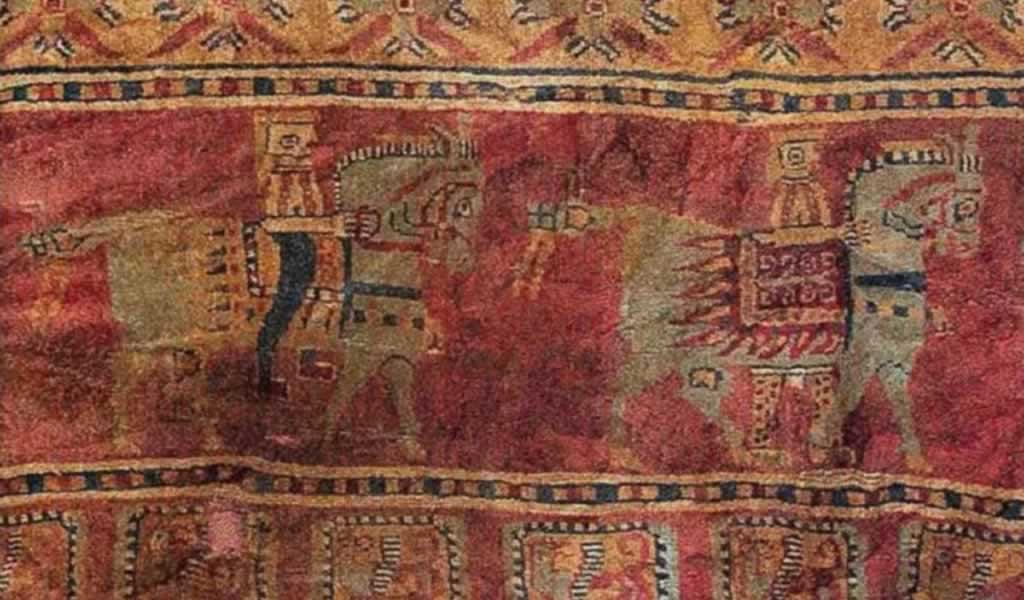
Original pile: rider and horse above the griffin squares. After Andreeva, Fantastic Beasts of the Eurasian Steppes (2018), detail of the Pazyryk 5 carpet.
The same boxed griffin drawn after the carpet. Fuat Tekçe, Altaylardan Bir Halının Öyküsü: Pazırık (Kültür Bakanlığı, Ankara, 1993, no. 1542).
First it keeps the dead. Griffin-marked things in these kurgans sit with the body, on the horse, on the coffin and on the skin. Çalış writes that such a placing is not accident: the creature was believed to safeguard the dead on their passage. Its predatory shape — beak, claw, gathered haunch — made it a watch against what should not follow. Other animals in the steppe style can guard. The griffin’s hybrid body was thought to hold a stronger, unearthly charge (Çalış, 2026; Mayor, 2022). Tekçe, looking at the deer of this same cloth, says the dead deer “goes to the sky” and carries souls (Tekçe, 1993, p. 116). The griffin is the one already waiting on that road.
Second it walks between worlds. Wings belong to the air. The lion body belongs to the ground. A being made of both can cross. For a people whose life was movement — camp to camp, earth to sky — that crossing was not a scholar’s diagram. Scythian and Inner Asian thought, read through the graves and through the older comparison, kept a layered universe: heaven, earth, the world below. The griffin is drawn leaping, flying, striking, because the work it does is not still. Burials, borders, horse gear: those are the doors. The griffin is set on the doors (Çalış, 2026; Lincoln, 1986).
Third it holds the world together. Animals in this cosmology do not stand to the side of men. They join men to the land and to what is not seen. A hybrid that can move between realms belongs in that joining. On funeral cloth, on ritual wood, on the gold of the high dead, the griffin could guide a soul, keep order, or show a power that does not answer to ordinary force. It is a picture of how life, death and the sacred were thought to sit in one house (Çalış, 2026; Rice, 1957; West, 2007). Malayev later reads the same walk on this rug: living animals on the rim, the griffin written as a sign in the middle, the soul coming loose.
None of this requires a Persian loom. Çalış is careful: Near Eastern cousins exist, and the Scythians did not copy them blindly; they took a hybrid that already fitted the steppe taste for force, motion and the edge between worlds, and made it their own (Çalış, 2026). Andreeva, mapping the same animal style across the Eurasian steppe, sets this carpet among Altai textiles whose animals are not furniture from Persepolis but a local visual language of transformation (Andreeva, 2018). On this page that language is read as Hun-Altai and Turkic. Ögel had already given the bird a name in that house.
Bahaeddin Ögel labels the Pazyryk, Tuekta and Bashadar mounds Altay Hun çağı and prints the hybrids as Turkish mythological types (Ögel, Türk Mitolojisi I, 1993). Şekil 7: a dragon with a deer in its jaws; an eagle-headed horse on wolf or tiger feet. Chapter XIII is called Türk Mitolojisinde Kartal. There the eagle is Tengri’s messenger; noble clans were eagle-clans; a shaman’s soul is taken by the bird, laid as an egg on the world-tree, and hatched under Eagle-Mother. Kartal-Ata stands with Deer-Father and Bear-Father (Ögel I, pp. 34–38, 595–598). That is the sky half of the animal on the border: later kartal and ejder, in Kazakh still italakaz. The Greeks, far to the west, called the Altai people themselves the griffins who guard gold.
Ögel, Şekil 7. Hun-age Pazyryk, Tuekta and Bashadar: dragon with a deer in its jaws; eagle-headed horse with wolf or tiger feet; sacred goat in combat.
Ögel, Chapter XIII, “The Eagle in Turkish Mythology.” Şekil 61: sky eagles on Bashadar and Tuekta cloth, with sun, moon and day-night signs.
The horse that is called brother
On this carpet the horse is not decoration. It is an ongon — a guardian animal a people will not give up. The old line still said in the epics is enough: “I do not call you horse. I call you brother.” That sentence was already art before it was proverb (Özkartal, 2012).
The wide horseman frieze. Cropped mane, knotted tail, carpet-like shabrak, a man walking at the left shoulder. Twenty-eight of them go against the deer.
Count them as you walk the second wide border, from the outside in. Twenty-eight horses. Every tail is tied. Every head carries a crest. They do not follow the deer; they take the opposite road. Some men ride. Some walk at the horse’s shoulder, one hand on the back — the old steppe way of leading a mount that is already dressed for ceremony. Colour and cut do not change along the band. The horses are one colour. The manes are shaved. The tails are bound (Özkartal, 2012).
Late Han pictures of Hun cavalry show the same mark: tails cut or knotted. Later Turkish pictures almost never leave the tail loose. When Bamsı Beyrek is thought dead, the Dede Korkut tellers do not speak first of the grave. They say the grey horse’s tail was cut — ağ boz atının kuyruğunu kestiler (Esin, 2004, p. 282; Ergin). Kazakh still has a verb for it: tullamak, to widow the dead man’s horse. Kirghiz tie the tail to a grave pole (İnan, 2000). Kashgari already knew the campaign version: “We tied the tail tight… we praised God much… we spurred the horse” (Dīwān I/472). Binding the tail and cropping the mane are read as a sign of mourning (Karamağaralı, 1998, p. 175; Özkartal, 2012).
Rudenko saw a Persepolis groom in the walking man (1970, p. 304). The pose can travel. The knot in the tail, the shaved mane, the felt shabrak painted with S-hooks — those stay with the people who call the horse brother. On this frieze they are not a hunting party. They are a funeral going the other way from the deer.
Saka riders and the pointed cap
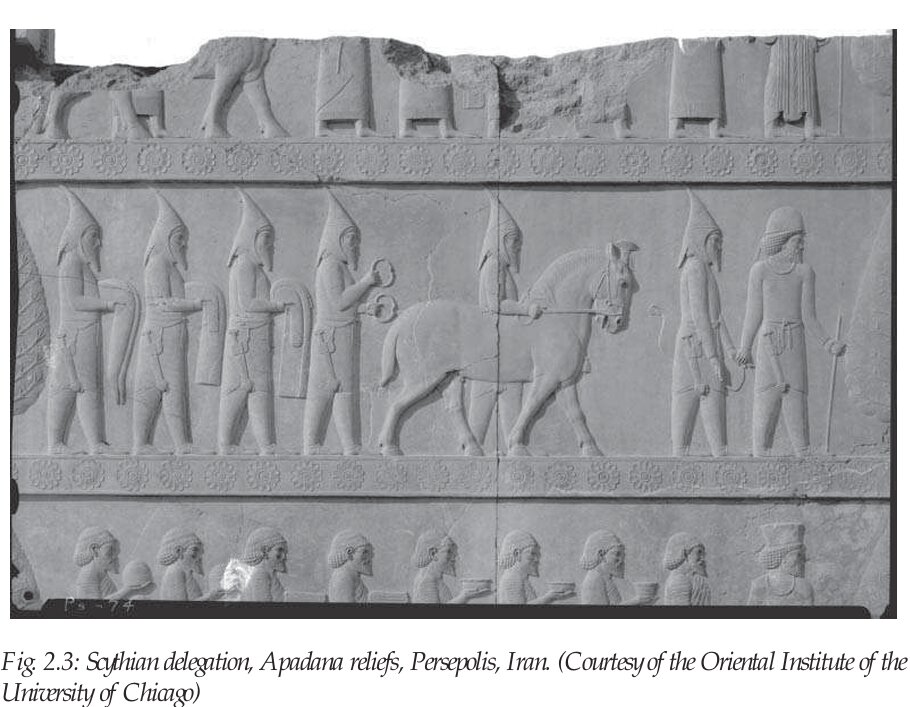
Clothes are a language. For the horsemen the Persians called Saka and the Greeks called Scythians, the tall word in that language was the hat (Gleba, 2008).
Herodotus lists Xerxes’ Saka troops: “tall caps, erect and stiff and tapering to a point; they wore breeches, and carried their native bows, and daggers, and axes which they call sagaris. These were Amyrgian Scythians, but were called Sacae; for that is the Persian name for all the Scythians” (7.64). He names the hat kyrbasia. Achaemenid inscriptions isolate one nation as the pointed-hat Saka — Saka tigraxaudā. Greeks and Persians both used the cap as the ethnic mark (Gleba, 2008).
On the rug: pointed cap, trousers, cropped mane, knotted tail. The same vocabulary Herodotus wrote down.
Apadana, Persepolis: Saka gift-bearers in the tall pointed cap, leading a horse (Gleba, 2008, fig. 2.3; Oriental Institute, Chicago).
On Attic vases the kit shrinks to two signs: the pointed cap with ear- and neck-flaps, and patterned trousers under a long-sleeved jacket (Gleba, 2008). Darius’ tomb at Naqsh-i Rustam labels three kinds of Saka and tells them apart almost only by the hat. At Bisitun the last bound rebel is named Saka and stands out by the height of his cap. The Apadana procession Rudenko compared to the rug is that same nation walking toward the king.
What the Altai kept matches the written kit. Pazyryk and Ukok graves of the fifth to third centuries BCE held complete garments: a hemp shirt sewn from panels in Kurgan 2, tailored sleeved coats, trousers, felt stockings. Scythian tailoring is cut and sewn, not a Greek drape pinned with a fibula (Gleba, 2008; Rudenko, 1970). On this carpet the men wear the short working version: pointed cap, close trousers, felt shabrak. The peak is not as theatrical as a red-figure vase. It is the rider’s hat.
Rudenko read the walking groom as a Persepolis tribute pose. Gleba’s point cuts the other way. Persepolis carved the Saka because the hat already named them. The weaver of Kurgan 5 was not quoting a palace relief. He was dressing his own people in the cap by which the empires already knew them.
Deer — geyik, the old ongon
An ongon is not a decoration. In the old Tengri faith it is a body that holds a spirit. God did not walk the earth in person; God showed himself in ongons — as a North American nation shows itself in a totem. The deer on this carpet is that kind of thing.
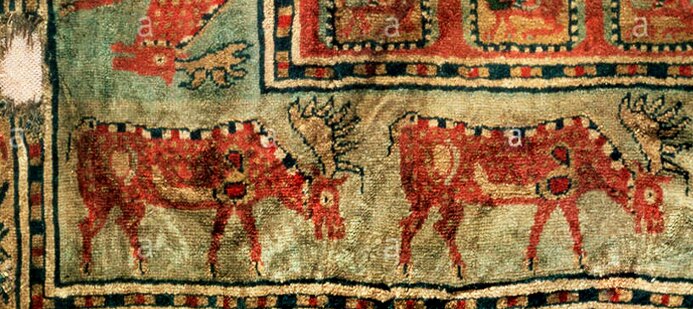
Spotted stag and calf. Drawing after Fuat Tekçe, Altaylardan Bir Halının Öyküsü: Pazırık (Kültür Bakanlığı, Ankara, 1993, pub. no. 1542). The same branched, spotted animal walks the inner wide border of the carpet.
Rudenko first wrote “elk,” then “fallow deer,” because of the spots (1970, p. 302). The pile itself is plainer than the argument: twenty-four branched, spotted deer, walking one way, while twenty-eight horses walk the other. Balcı notes that the oldest deer on Turkish textiles already stand on Pazyryk felt and on this rug — realistic, forked antlers, speckled flanks — and that the same spotted stag on the kurgans’ appliqué felts is already being taken by a predator (Balcı, 2012). That is not a hunt for the pot. Steppe stories say the deer does not end when it dies. It goes to the sky. Siberian and Inner Asian peoples kept that as the reason a soul can ride a deer to the other world (Tekçe, 1993, p. 116; Balcı, 2012).
Long before the Hun kurgans, Scythian-Siberian thought set the deer next to the Mother Tree: creator, source of life, animal-mother of the clan. Sun, gold and deer were one thing. Antlers were the tree growing out of the mother’s body (Jacobson, 1993; Dalkesen, 2015). Göktürk inscriptions and Chinese notices still treat the deer as an ongon. A Göktürk lord’s white hind — ak geyik — is a goddess-animal; the man who kills her is punished. Tong Yabgu kept tamed elk in the woods near Talas, bells on their necks. The kaghan line is tied to the sığın geyik ongon on coins of the Tokharistan yabghus (Esin, 2003; Balcı, 2012). Kirghiz shamans still name deer and white hind as helper spirits; the clan name Bugu is the deer itself (Atnur, 2005; Balcı, 2012).
When the steppe took the horse and the wolf as the marks of the khan, the deer did not leave. It dropped from the throne to the people. After Islam it walks beside the saints: Geyikli Baba, Hacı Bektaş with a deer under his arm, Abdal Musa. In Anatolia a sick man’s head is still laid toward a deer horn so that he may go either to God or back to health (Dalkesen, 2015). The kilims flatten the drawing. The name stays geyik. On this carpet the twenty-four deer are not game. They are the old ongon, walking the road the horses refuse.
What the later rugs still call these figures
No mixed poster. Six correspondences, one line each. The left column is what is on the Pazyryk cloth. The right column is the name a Turkish or Turkmen weaver still uses. Meaning is the part that did not change.
On the Pazyryk carpet
In Anatolian and Turkmen rugs
What is kept
24 four-rayed lotus-star squares
gül / yıldız / göl (rose, star, lake)
Sun, rebirth, the clan field (Tekçe 1993; Rejepova 2021)
S-hook on the saddle cloths
koçboynuzu / çengel (ram’s horn, hook)
Power, fertility, continuity (Ergun 2004; Erbek)
Griffin (eagle + lion)
kartal + ejder (eagle + dragon)
Sky and earth; Tengri’s envoy (Ögel 1993; Çoruhlu)
24 walking deer
geyik
Ongon; animal-mother; soul’s mount (Tekçe 1993; Balcı 2012; Dalkesen 2015)
Horseman, cropped mane, knotted tail
at
“The horse is the wing of the Turk” (Kashgari)
Four-way centre field
tört bulung / hayat ağacı
Four corners of the world; tree of life (Tekçe 1993)
Red, yellow and blue stay the working palette: courage, sun, integrity — the same madder-and-indigo family as later Anatolian wool (Çeken & Bal, 2026).
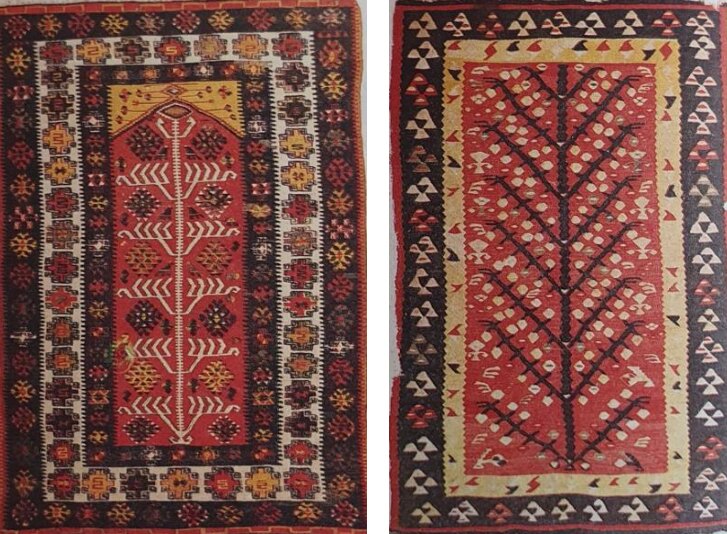
The tree of life — from the Altai saddle to the Anatolian mihrab
Turkish communities have long read a tree as the picture of a life that does not finish. A tree rises, branches, drops seed, and stands again. A human life, seen from the steppe, does the same. From Inner Asia to Anatolia it was therefore a sacred task to plant trees by the house and by the grave (Arslan, 2014, p. 60; Tüm Cebeci, 2022). Güran Erbek wrote that the tree is the shared theme of the religions that name one God. The fruit that promised not to die was barred to mortals; after that, hope for the life that follows death was hung on the tree of life (Erbek, cited in Tüm Cebeci, 2022).
On this carpet the tree is not yet the tall plant of a village kilim. It is written small and written often. The S-hooks painted on the horseman’s shabrak are the old sign of a line that turns and does not end — the same turn later Anatolian weavers call koçboynuzu and, in some readings, a compact tree of life (Ergun, 2004; Tekçe, 1993). The twenty-four lotus squares in the field open on four sides: Tekçe names that opening tört bulung, the four corners of the world, which is the tree seen from above. The deer that “goes to the sky” climbs that tree (Tekçe, 1993, p. 116). The griffin waits in its branches.
On the Pazyryk pile the tree is still a sign on the horse: the hooked S on the shabrak, the four-way field behind the rider.
The same tree, opened into a trunk and branches, standing in the mihrab of Anatolian kilims. After Erbek, Kilim Catalogue No. 1 (Selçuk A.Ş., 1988); plates as reproduced in Tüm Cebeci, 2022.
In Turkish weaving that tree became one of the motifs used most. It is drawn as life and as endlessness. Because people saw their own span in the span of a tree, the tree itself was held holy from Central Asia into Anatolia (Tüm Cebeci, 2022). On kilims it usually stands in the middle field or inside a mihrab. Birds on the branches are life and soul. A dragon above the niche is the guard of the tree (Erbek, 1988, p. 40; Tüm Cebeci, 2022). The drawing changed. The office did not. What the Altai knotted as a hook and a four-fold star, the later loom still calls hayat ağacı.
The 24 squares as Turkmen göl — and as the sons of Oghuz
Nazgul Rejepova, writing on Turkmen carpet art, calls the centre field the “lake” motif (göl): six by four, twenty-four squares, “an indispensable motif for the Turkic people.” Persian carpets became famous for a later medallion type; this field is not that type. The same 24-lake layout is still woven on Turkmen carpets. In the Oghuz reading used in Turkmenistan, the twenty-four lakes stand for the twenty-four grandsons of Oghuz Khan and the six compartments for his six sons (Berdimuhamedov, 2007, p. 100; Rejepova, 2021). That genealogy is later than the Ice Age grave. The point is not that the Pazyryk weaver had the Oghuz-nāme in her head. The point is that the living Turkic carpet language still names this field as its own, and still ties it with the Gördes knot (Rejepova, 2021; Aslanapa, 2005).
Yeşildal’s conclusion can be repeated without softening it: even if knot, geography and the rest of the grave were set aside, the deer, the horse and the griffin would still mark the cloth as Turkic (Yeşildal, 2018).
Deer above, riders below. The two friezes run in opposite directions.
Original pile: cap, shabrak and cropped mane still readable after 2,500 years.
From the living edge to the silent centre
Alibek Malayev, writing from Almaty, treats the carpet as a road the dead were meant to take. You begin at the rim, where every figure still has a name. You end in the middle, where the names have already fallen away.
Imagine the cloth spread on the floor of the chamber, and walk it inward as he would have walked it.
The first people you meet are still dressed for this world. Caps, trousers, horses whose tails have been knotted for war or for mourning. You could call each of them by an ordinary word. A little farther in, the deer go by — twenty-four of them, and they do not follow the riders. They take the other road. Then the griffin appears, eagle-headed, lion-bodied, pacing the inner band and the outer one. Until this point the rug is still a picture. A child could put a finger on it and say: horse. Deer. Bird-beast.
Then the centre opens, and the picture stops.
Rudenko, trained to look for gardens, saw flowers there. Malayev says that is a Western wish. What sits in those twenty-four squares is the same griffin, only now written as a sign: paws laid on the cross, wings laid on the diagonals. Kazakh still keeps a name for that hybrid — italakaz, the dog-goose. Far to the west the Greeks, who never stood in this valley, called the Altai people the griffins who guard gold.
So the creature is drawn twice: once as an animal you can follow around the border, and once as a cross you can only read. The rest of the graves had already finished that sentence. A man in Kurgan 2 wears the same combat on his skin. A felt saddle from Kurgan 1 shows the griffin with a ram already in its grip. On the Bashadar coffin the tigers walk over rams. In the carved wood a ram and a wolf twist until their hindquarters face the wrong heaven; an elk hangs in a griffin’s claws. The back half of the animal has left the ground. Flesh is turning out of the world. Spirit is still fighting.
That is how Inner Asia drew the hour when a soul comes loose — not in a single instant, but as a slow unforming. Later custom would count it on the third day, the seventh, the fortieth, and the anniversary of the death (Toleubaev, 1991; Malayev, Altaica).
Malayev plate: the corner where picture-language (rider, deer) meets ornament-language (the centre crosses).
From the same culture, not from Persepolis: griffin on a Kurgan 1 felt saddle; tigers on the Bashadar 2 coffin. The carpet’s griffin is this animal, abstracted.
Kurgan 2 tattoos. Animal combat is written on the owner as well as on the textiles.
Twisted rams and wolf; elk in a griffin’s claws. The hindquarters have already left the living axis.
The mountain and the way home
Nothing on this cloth walks in one direction only. Deer go left to right. Riders go right to left. Inner griffins face one way, outer griffins the other. In the old stories shared by Kazakh, Karakalpak, Tatar, Uzbek, Khakas, Buryat and Mongol tellers — the cycle called Forty Fables — the land of the dead is a mirror. You are born before your parents. You walk without a head. The living world and the other world face opposite ways.
So Malayev names two roads on the same square. From the rim toward the middle is “the way to the mountain”: the dead man coming apart, sign by sign, until only the abstract griffin is left. From the middle back to the rim is “away from the mountain”: a soul taking on a body again — riders, horses, a people. Twenty-four signs in the field face twenty-four deer. Each deer already has its griffin waiting.
That is the old hero’s road: into the land of the dead, and home again with what cannot be said in pictures anymore. A palace rug sent from Persepolis would not be this map. The tattoos, the felt, the twisted wood and the horses in the same ice are already telling the same story. The carpet is the last page of that story, laid on the floor of the grave (Malayev).
Why the red still holds — and why Anatolia appears in the laboratory
Colour fastness is not luck. It is chemistry. Two laboratory generations have now looked at the red: Böhmer in 1991, then synchrotron imaging in 2021.
Böhmer’s thin-layer chromatography found carminic and kermesic acids in the pile at about 8:1 — the fingerprint of a northern steppe cochineal (Porphyrophora polonica or a Kazakh sister species), not of Mediterranean kermes and not of Ararat kermes (ratio ~40:1) from the Iranian plateau. The same insect red is in the Kurgan 5 felts. That is why Böhmer and Thompson wrote that the carpet did not come from the plateau (1991, pp. 33–34). Whiting (1985) had already seen the same acids by UV spectrophotometry.
Mordant — a metal salt (here alum, KAl(SO₄)₂) that binds dye to wool as a metal–organic complex. Turkey red — the madder (Rubia tinctorum) + aluminium complex; alizarin is the main colourant. Fermentation dyeing — wool is left about three weeks with Geotrichum candidum before dyeing. The yeast lifts cuticle scales and opens the cell-membrane complex, so pigment goes deeper (Späth et al., 2021). μ-XRF — micro X-ray fluorescence: a synchrotron beam maps metals inside a single 30–50 µm fibre.
Späth, Meyer, Barkova and colleagues found the same inner pigment map in Pazyryk fibres and in Anatolian wool that had been fermented then dyed with madder and alum. Unfermented controls did not match. They conclude that the fermentation method — described from eastern Anatolian practice since the 1970s revival — was already in use about two thousand years earlier than previously documented (Späth et al., 2021). Chromatography had already shown that the Pazyryk culture used Rubia.
This does not prove the loom stood in Anatolia. It does prove that the Pazyryk dye shop and the later Turkish village shop belong to one technical family. That family is the one that produced Gördes-knot carpets.
Späth, A. et al. (2021). X-ray microscopy reveals the outstanding craftsmanship of Siberian Iron Age textile dyers. Scientific Reports 11, 5141. Sample courtesy of the State Hermitage; L. L. Barkova co-author.
The Scythians of this valley were Turks
The Greeks had one name for the horsemen of this steppe. The graves have another. The same people are later called Hun, and later still Turk.
Some writers have tried to make them Persian. A few words look similar. The bodies and the mounds do not. A Greek who watched a Persian king ride north against them wrote the plain thing: in face, in war, in custom, these riders were not Persians (Herodotus).
What follows them from valley to valley is a way of living and of dying. Durmuş places them in that steppe line — not a Persian province that happened to keep horses, but an early Turkic people whose later face is the Hun. Hasanov, in Belleten, does not lean on a single word. He sets one rite beside the next and watches the same acts return (Durmuş, 2008; Hasanov, 2016).
Herodotus watched the funeral of a Scythian king. The body did not go straight into the ground. It was carried from camp to camp. At each stop the mourners cut their faces, shaved their hair, and let blood. Forty days the dead man travelled. Then a great pit was dug. A wife, a cup-bearer, a cook, a groom and a messenger went in with him, and gold cups beside them. Earth was heaped until the pit became a mound. A year later the people came back. Fifty of the best horses and fifty of the best servants were killed, set on poles, and left standing around the mound as if still on watch (Herodotus IV; Hasanov, 2016).
Read that against the later steppe and the picture does not change. Huns buried servants with their lords. At a great funeral they tore their hair and opened their faces so that tears ran with blood — the same wound. Later Turks cut hair and cheek for a dead ruler and gave him their own horses. Forty days could still be the length of the road. The horse was still for the other world. The mound in this valley — timber chamber, horses in the pit, carpet under the ice — is that rite caught in frost (Durmuş, 2008; Hasanov, 2016).
That mound is not a fashion. It is a house built for a father who will wake and need his mount, his weapons, his gold. Sky-god faith written in earth: there is a life after this one; the ancestor must be kept ready. From the Altai to the Black Sea those mounds rise. This valley is one room in that house.
Herodotus also watched how friendship was made. Wine was poured into a bowl. Each man cut his skin. The blood went into the wine. A sword, arrows, an axe and a spear were dipped in. They drank. Huns climbed a mountain, cut a white horse, mixed the blood with wine, and drank from the same kind of cup. Victory used one cup more: the skull of an enemy, cleaned and set on the feast table — Scythian and Hun alike (Herodotus IV; Hasanov, 2016).
The knot on this cloth is the knot later Turkish looms kept. The horse on the border is the horse in the pit. The people who cut the stone and laid the rug in the ice were Scythians when a Greek was speaking, and Turks when the grave is allowed to speak (Çeken & Bal, 2026; Yeşildal, 2018).
Tattoos from the same culture. Animal style on skin and animal style on wool are one language.
Opening a stone-ringed mound. Kurgan 5 was this kind of architecture, not a palace floor.
Kün-ay — the sun and the moon that travel with the Turks
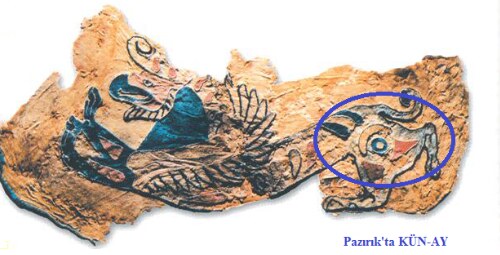
On the deer of this carpet a disk sits on the flank. In another find from the same mounds the same meeting is drawn on a bird: sun and moon together. The old Turkic name for that meeting is kün-ay.
Emel Esin followed the sign from the proto-Turkic age to the later khans. Today’s crescent and star, she wrote, is the picture of sun and moon standing in the sky at once. The motif is already there in the first millennium before our era. Hun rulers honoured sky, sun and moon; the sun and the moon were spoken of as father and mother of the prince. Kün is both sun and day. Ay is moon, and among Turks a sign of kut — the fortune that sits on a lord. When the two are seen together they are kün-ay: brightness at its height, the blessing of rule (Esin, 1972).
The deer border on the original pile. Disk and ring on the flank — the body marked as the sky marks a lord.
From the same culture: sun and moon drawn on the animal. The later label is the old word — Pazırık’ta kün-ay.
The sign does not stay in the ice. Göktürk and later stones write ay as a bow or a round. Northern courts blessed a new ruler with the sentence: shine like the sun and the moon in the sky. Coins of early Turkic houses carry the same pair — disk and crescent on the crown, on the field, on the banner. Uyghur texts know three names: Sun-god, Moon-god, and Kün-ay tengri, the god of their meeting. A khan who had kut in both lights had the full blessing (Esin, 1972).
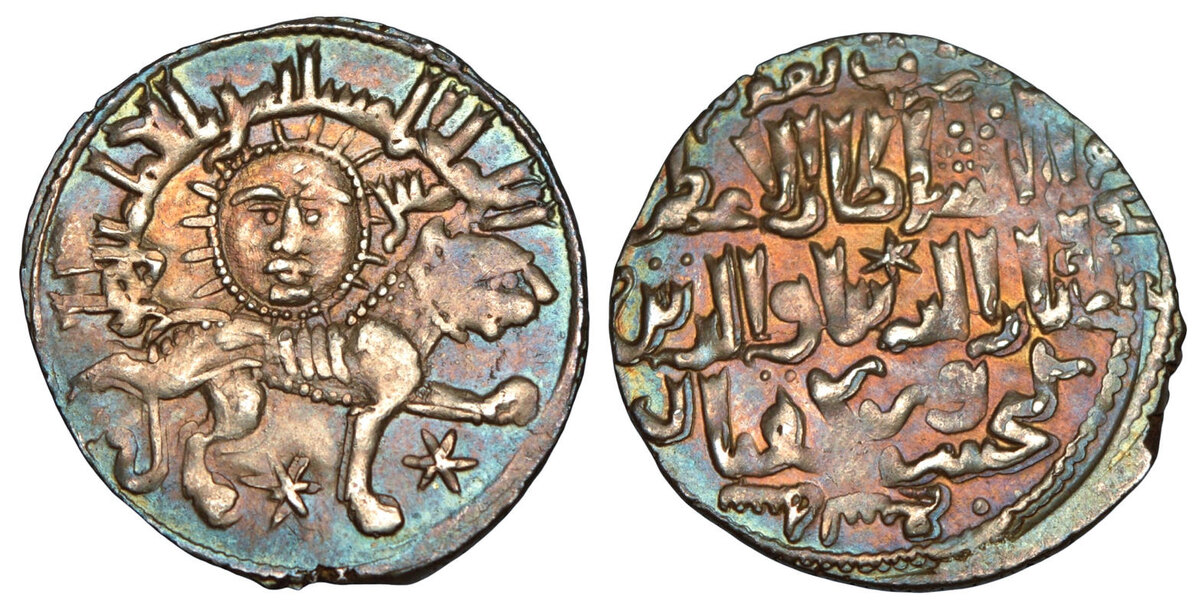
Seljuk and later banners still say mihr ü mah — sun and moon. In Anatolia the sun takes a face and rides a lion: the coin of Kaykhusraw II. Ottoman flags keep the pair as crescent and star. A soldier’s cap still carries the moon. The drawing changes. The office does not.
Rum Seljuk dirham of Kaykhusraw II: sun-face over the lion, stars in the field. The sky still marks the lord.
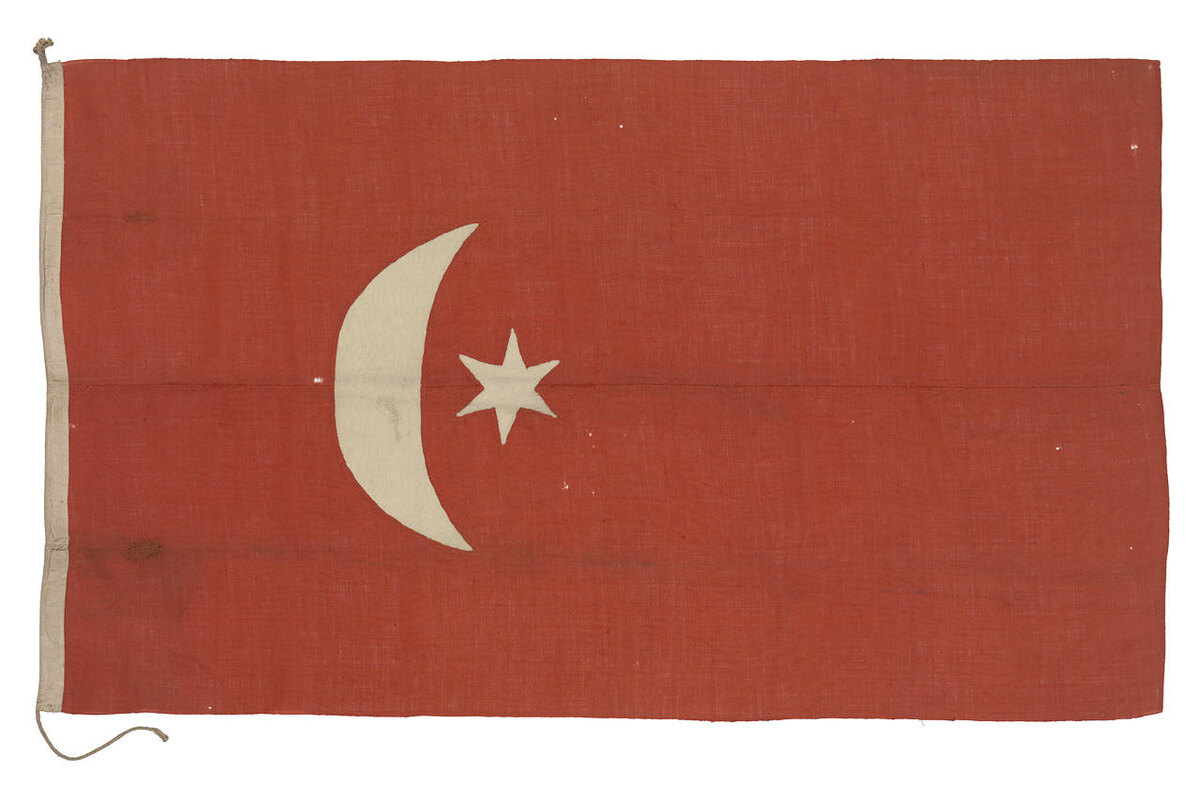
Ottoman ensign after 1844: moon and star on red. The old kün-ay written as a flag. Royal Museums Greenwich.
So the disk on the Pazyryk deer is not a stray spot. It is the sky written on the ongon that carries souls. Sun and moon travel with the people who buried this rug (Esin, 1972).
The frieze was never still
Ice stopped the wool. It did not stop the walk that was already knotted into it.
Look again at the cavalry. Under each horse the weaver laid a run of slanted stitches. Those stitches are not decoration. They are a direction. The men lean into them. Some ride, some walk at the shoulder, but the line itself is already going forward — toward a fight, or toward the grave, which on this cloth are not two places (Çeken & Bal, 2026; Çoruh & Terlemez, 2022). Turn inward and the deer take the other road, twenty-four of them, comma and disk on the shoulder so the body seems to roll as it passes. The griffin in the narrow bands does not pose; wings and ears are up. Even the lotus in the twenty-four squares opens on four sides, as if the centre were breathing (Tekçe, 1993). Red is the courage of the field. Yellow is the sun that does not set with the man. Blue holds the two together (Çeken & Bal, 2026).
Two and a half thousand years later Birsen Çeken and Gamze Bal lifted twenty-four of those figures off the cloth — rider, deer, lotus, griffin — and let a machine finish the step the knot had already begun. They added sound. They did not do it to decorate a museum label. Their paper names the find without a hedge: a carpet from the kurgans of the Hun Turks, the first work of Turkish carpet art, taught again so that a living eye can see what a frozen eye was meant to see (Çukurova University Journal of the Institute of Social Sciences, 2026).
The screen is only a late loom. What moves on it moved first in wool, then in ice, then in the graves that still keep the same animals on felt and skin. A student who watches the deer walk is not watching a trick. She is being shown the sentence the weavers wrote and never needed to sign.
The mound is closed. The horses in the pit have been counted. The red still holds. And on the cloth the riders have not yet arrived, and the deer have not yet gone, and that is how the story of this rug ends — still walking.
Glossary of technical terms
Pile carpet / knotted carpet — a textile whose visible surface is cut yarn ends standing up from knots, not a flat tapestry or felt.
Felt carpet — wool beaten into a sheet, often with appliqué. Pazyryk produced both: the famous knotted rug and larger felt hangings (Çırpıcı, 2015).
Shabrak — a textile saddle cloth laid on the horse instead of, or under, a wooden saddle. On this rug the horses wear fringed, carpet-like shabraks (Rudenko, 1970, pp. 303–304).
Frieze / border — a horizontal band of repeating figures. Pazyryk uses five, alternating narrow and wide (Rudenko, 1970, p. 300).
Kyrbasia / Saka tigraxaudā — the tall, stiff, pointed cap of the Saka. Herodotus’ name for the hat; the Achaemenid name for the “pointed-hat Scythians.” The main ethnic mark of the riders on this carpet (Gleba, 2008; Herodotus 7.64).
Kün-ay — sun and moon seen together. Old Turkic name for the meeting of the two lights; later the crescent-and-star. A sign of kut, the fortune of a lord (Esin, 1972).
Ongon — in old Turkic Tengri belief, a body that holds a spirit. Comparable to a totem. Tengri did not appear on earth except through ongons. The deer, the horse and the eagle on this page are read as ongons, not as ornaments.
Saka / Scythian — Greek and Old Persian names for the horsemen of the steppe. On this page they are read as early Turkic (Ogur / Hun-Turk) communities, not as an Iranian people by default (Şengül, 2024; Çeken & Bal, 2026).
Koçboynuzu — ram’s horn. Anatolian sign of power, masculinity and fertility. The living relative of the Pazyryk S-hook.
Gül / göl / yıldız — rose, gul-medallion and star. Anatolian heirs of the Pazyryk four-rayed lotus square.
Ejder / kartal — dragon and eagle. Anatolian heirs of the griffin: sky and earth, rain and sovereignty.
Hayat ağacı / tört bulung — tree of life and the four corners of the world. The vertical and the square versions of the same Turkic cosmos.
Elibelinde / bereket — hands-on-hips (feminine fertility) and the combined fertility sign. Not drawn as such on Pazyryk, but the later pair that absorbs the ram’s-horn half of the old S-hook.
Permafrost lens — a pocket of ground ice. After the robbery, water froze here and became the rug’s conservator.
Where the rug is now
State Hermitage Museum, St. Petersburg. Inventory often cited as 1687-93. Guinness lists it as the oldest surviving pile carpet, radiocarbon-placed around 2,400–2,500 years ago. Replicas exist in the Carpet Museum of Iran and in commercial workshops; they are copies, not the frozen original.
Function is still open: carriage lining, tent floor, or funerary cloth. Size fits all three. The grave context means it was valuable enough to go into the next world with its owner (Schürmann, 1982; Rudenko, 1970).
Sources used on this page
Every claim above is tied to one of these. Titles are given in the language of publication.
Rudenko, S. I. (1970). Frozen Tombs of Siberia: The Pazyryk Burials of Iron Age Horsemen. Especially pp. 174, 257, 273–274, 299–304.
Xalîkanî, F. T. (2025). Pazyryk Halısı Üzerine Teknik ve İkonografik Bir İnceleme: Rudenko Kaynaklı Bir Çözümleme. Technical digest of Rudenko, including Bashadar comparison.
Çeken, B. & Bal, G. (2026). Animating Turkish Motifs with Contemporary Technology: The Case of the “Pazyryk Carpet.” Çukurova Üniversitesi Sosyal Bilimler Enstitüsü Dergisi, 1–16. DOI: 10.35379/cusosbil.1664559.
Yeşildal, Ü. Y. (2018). Hayvan Sembolizmi Bağlamında Pazırık Halısı. In Yeşil & Yıldırım (eds.), 2. Uluslararası Türk Dünyası Eğitim Bilimleri ve Sosyal Bilimler Kongresi Bildirileri, vol. 3, Türkoloji–Filoloji. Ankara: Türk Eğitim-Sen.
Hasanov, Z. (2016). İskit ve Türk-Moğol halklarına ait aynı gelenekler, kültler ve psikolojik özellikler (trans. B. Musa). Belleten, 80(288), 639–666. Funeral of forty days, face-wounding, horse around the kurgan; blood-oath; skull cup — Scythian, Hun and Göktürk.
Esin, E. (1972). “Kün-Ay” (Ay-Yıldız motifinin proto-Türk devirden Hakanlılara kadar ikonografisi). In VII. Türk Tarih Kongresi, I. Cilt. Ankara: Türk Tarih Kurumu, pp. after the 1970 congress. Sun-and-moon from proto-Turkic pictograms through Hun, Göktürk, Uyghur and later banners.
Durmuş, İ. (2008). İskitler (Sakalar). Ankara: Genelkurmay ATASE. Scythians as an early Turkic / Hun steppe people.
Çırpıcı, A. (2015). Pazırık Kurganlarından Çıkan Yapıtların Araştırılması, Çağdaş Bir Görüşle Günümüz Sanatlarına Uyarlanması. Sanatta yeterlik tezi, Haliç Üniversitesi, İstanbul. Advisor: Prof. Dr. Esin Sarıoğlu.
Şengül, F. (2024). The Origin of the Scythians and the Identity of the Scythians and the Alans in John Tzetzes’ Work. JOTS 8(1), 104–129.
Späth, A., Meyer, M., Huthwelker, T., Borca, C. N., Meßlinger, K., Bieber, M., Barkova, L. L. & Fink, R. H. (2021). X-ray microscopy reveals the outstanding craftsmanship of Siberian Iron Age textile dyers. Scientific Reports 11, 5141.
Aslanapa, O. (2005). Türk Halı Sanatının Bin Yılı. İstanbul: İnkılâp.
Gleba, M. (2008). You Are What You Wear: Scythian Costume as Identity. In Dressing the Past. Pointed cap (kyrbasia), trousers and tailored jacket as the Saka ethnic mark; Herodotus 7.64; Apadana fig. 2.3; Pazyryk–Ukok garments.
Erbek, G. (1988). Kilim Catalogue No. 1. Istanbul: Selçuk A.Ş. Ana Basım Yayınları. Anatolian kilims with the tree of life in the mihrab; plates cited via Tüm Cebeci, 2022.
Tüm Cebeci, D. (2022). Hayat ağacı motifinin Türk dokumacılık sanatına yansımaları / Reflections of the Tree of Life Motif on Turkish Weaving Art. Kesit Akademi Dergisi, 8(30), 262–286. DOI: 10.29228/kesit.57430.
Andreeva, P. (2018). Fantastic Beasts of the Eurasian Steppes: Toward a Revisionist Approach to Animal-Style Art. PhD dissertation, University of Pennsylvania. Pazyryk 5 carpet figs. 3.1–3.2; griffin and hybrid animals in Altai textiles.
Çalış, S. M. (2026). The Symbolic and Mythological Dimensions of the Griffin Motif in Scythian Art. Design Nexus, 2(1). Guardian of the dead, mediator between worlds, cosmological integration; Pazyryk griffin textiles.
Tekçe, F. (1993). Altaylardan Bir Halının Öyküsü: Pazırık. Ankara: Kültür Bakanlığı Yayınları, no. 1542. Deer drawing; griffin square drawing used on this page; the dead deer “goes to the sky” and carries souls (p. 116).
Balcı, N. (2012). Türk Halı Sanatında Mitolojik Kaynaklı Bazı Motifler. Deer as ongon; Göktürk white hind; Pazyryk as the oldest textile deer; Tekçe drawing.
Dalkesen, N. (2015). Orta Asya’dan Anadolu’ya Türk Kültüründe Geyik Kültü. Millî Folklor 27(106), 58–69. Deer with Mother Tree as clan-ancestor; later saint and healing cult.
Jacobson, E. (1993). The Deer Goddess of Ancient Siberia. Leiden: Brill. Cited after Dalkesen.
Çoruhlu, Y. (2011, 2014, 2019). Works on Turkish animal symbolism and mythology.
İnan, A. (1998, 2000). Studies on pre-Islamic Turkic funerary custom and shamanic verse.
Mahmud al-Kashgari (2013 ed.). Dīwān Lughāt al-Turk.
Ergin, M. (1999). Dede Korkut Kitabı.
Sarıyev, and related motif studies cited in Çeken & Bal (2022–2025 cluster).
Schürmann, U. (1982). The Pazyryk: Its Use and Origin — funerary-cloth hypothesis; Armenian workshop thesis, recorded here only as a rival view.
Özkartal, M. (2012). Türk Destanlarında Geçen Halı Anlatımları, Halılardaki Hayvan Motifleri ve Renklerinin Dili. Horse as ongon; knotted Hun–Pazyryk tails; Bamsı Beyrek; mourning mane and tail (Esin 2004; Karamağaralı 1998).
Esin, E. (2004). Türk Sanatında İkonografik Motifler. İstanbul: Kabalcı. Bamsı Beyrek: the grey horse’s tail cut at the report of death (p. 282).
Karamağaralı, B. (1998). Halı Sanatı Üzerine. In Türk Soylu Halkların Halı Kilim ve Cicim Sanatı, Kayseri 1996. Ankara: AKM. Knotted tail and cropped mane as mourning (p. 175).
Ögel, B. (1993). Türk Mitolojisi, I. Ankara: Türk Tarih Kurumu. First printing 1969. Şekil 7 (Pazyryk–Tuekta–Bashadar hybrids), Şekil 8 (Altai eagle heads), Şekil 61–62 and Chapter XIII “Türk Mitolojisinde Kartal”; the mounds are labelled Altay Hun çağı.
Malayev, A. Pazyryk. A Method of Deciphering Ornament. Altaica. Almaty. Borders as picture-language, centre as abstract unforming of the dead; griffin, tattoos and twisted animals from the same kurgans as the context of the rug.
Toleubayev, A. (1991). Relikty doislamskikh verovanii v semeinoi obriadnosti kazakhov. Alma-Ata. Cited by Malayev for the 7th- and 40th-day stages of the soul.
Böhmer, H. & Thompson, J. (1991). The Pazyryk Carpet: A Technical Discussion. Source: Notes in the History of Art 10(4), 30–36. Hermitage fragment measured as “Turkish” knot; steppe insect red, not Ararat kermes.
Rejepova, N. (2021). Turkmen Carpet Art. In Güz & Ayhan (eds.), International Turkish Culture and Art Symposium Proceedings (29–30 October 2020), Etimesgut / Ankara, pp. 39–52. Pazyryk as Hun-Turkic work; 24 göl squares and Gördes knot.
Berdimuhamedov, G. (2007). Cited in Rejepova (2021) for the 24 grandsons / 6 sons reading of the lake field.
Whiting, M. C. (1985). A Report on the Dyes of the Pazyryk Carpet. In Pinner & Denny (eds.), Oriental Carpet and Textile Studies I, 18–22.
Guinness World Records. “Oldest carpet.”
Erbek, G. and the standard Anatolian kilim motif corpus (koçboynuzu, elibelinde, bereket, ejder, hayat ağacı, su yolu, yıldız) as summarised in later handbooks and in the public kilim-motif lists.
Çoruhlu, Y. (2011). Türk Mitolojisinin Ana Hatları; (2014). Türk Sanatında Hayvan Sembolizmi.
Diyarbekirli, N. (1972). Hun art and the deer as path-opener (cited in Çeken & Bal, 2026).
Wikipedia, “Knotted-pile carpet” and “Kilim motifs” — Ghiordes knot as the Pazyryk knot; motif glossary used only as a concordance, not as a primary excavation source.
This page is not for sale and does not claim legal title to any image. Photographs of the original are used for study. Motif drawings are modern readings, not facsimiles of the pile. Rudenko’s Persian-workshop suggestion is cited in full; the Turkic attribution is the thesis of this site, not a hidden consensus of all archaeologists.